
Special to WorldTribune, May 13, 2026 Real World News
Geostrategy-Direct, May 19, 2026
The U.S. is emphasizing a “coherent strategic geometry” with allies South Korea, Japan, and the Philippines in the Indo-Pacific theater, according to the U.S. Forces Korea (USFK) commander.
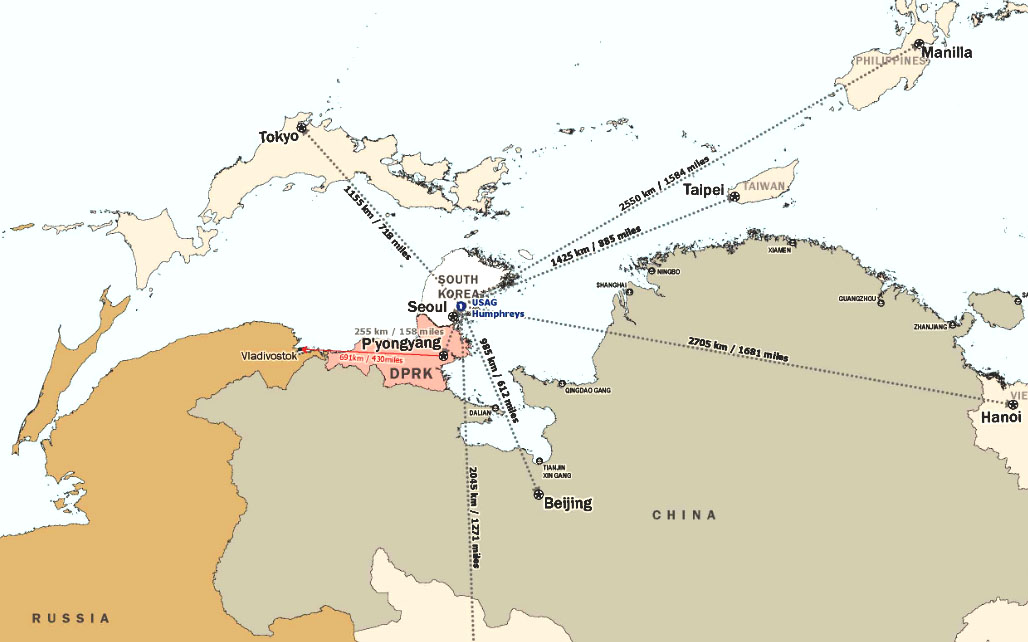
Gen. Xavier Brunson refers to it as an “East-up” strategic perspective, according to the USFK website.
“In Korea, we have that presence. We aren’t projecting power. Our alliance is our power,” Brunson said.
In a speech made at a May 5 symposium held at the U.S. Army War College, Brunson stressed the need to set aside the conventional “north-up” view of the world and consider an “east-up” perspective.
Unlike the conventional mapping that places North Korea and Russia north of South Korea, the east-up mapping tends to visually highlight areas south of the Korean Peninsula, including countries such as Taiwan and the Philippines.
Brunson said:
In the Indo-Pacific theater, where geographic relationships determine operational possibilities and alliance effectiveness, military planners may be overlooking critical advantages simply because of how they view their maps,” Brunson said. “By rotating our standard north-up orientation to place east at the top, a transformed strategic landscape emerges–one that reveals previously hidden geographic relationships.”
The standard north-up projection, with North America centered and prominent, creates an analytical framework that may obscure strategic realities in other theaters. This perspective, while familiar, can generate blind spots that limit strategic effectiveness.
Consider how this traditional view presents the Indo-Pacific: as a vast expanse with scattered islands and distant allies, where American forces must project power across enormous distances to reach potential conflict zones. This perspective emphasizes the challenges of power projection while minimizing existing advantages.
When the same region is viewed with east orientation toward the top, the strategic picture transforms dramatically. The first island chain, a cornerstone of Indo-Pacific strategy, takes on new meaning. Forces already positioned on the Korean Peninsula are revealed not as distant assets requiring reinforcement, but as troops already positioned inside the bubble perimeter that the U.S. would need to penetrate in the event of crisis or contingency. ….
Full Report . . . . Current Edition . . . . Subscription Information

U.S. Forces Korea commander flips map for winning ‘East-up’ strategic perspective added by Editor One on
View all posts by Editor One →