
Special to WorldTribune, May 21, 2026 Real World News
Geostrategy-Direct, May 19, 2026
By Richard Fisher
Elon Musk and his SpaceX Corporation have a great deal riding on the now twice-delayed May 21 (6:30pm EST) launch of their two-stage Starship V3, that at 5,300 metric tons (11.7 million pounds) fully fueled will be the largest ever space launch vehicle (SLV).
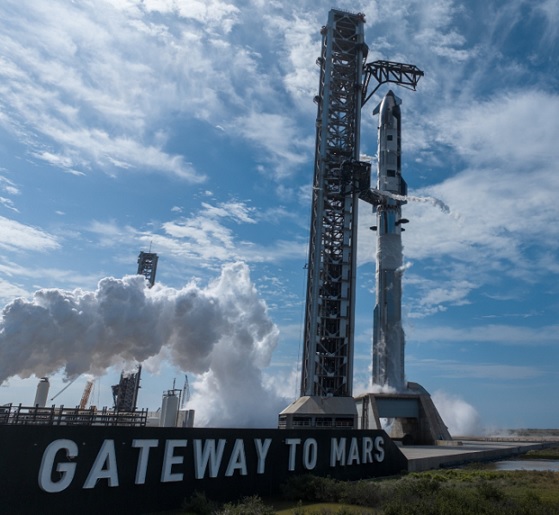
A successful Starship V3 test is extremely important for SpaceX, as it will drive timelines for future Starship versions, especially the Starship Human Landing System version for the planned 2028 United States return to the Moon, and to expand SpaceX’s ability to rapidly launch tens of thousands of its revolutionary Starlink broadband satellites — that it hopes to connect a new line of hand-held smart phones.
While Starship V3, with its jump in payload to 100 tons for Low Earth Orbit (LEO), compared to 35 tons for V2, gets closer to the capability required for missions to the Moon and Mars, V3’s first flight and the 12th Starship flight overall, is intended to test modifications that advance crucial goals of reusability.
For all SpaceX SLVs, achievement of reusability has been the fundamental innovation enabling ever lower SLV launch prices, driving SpaceX’s achievement of 165 space launches in 2025, accounting for 86 percent of all U.S. space launches and 51 percent of global launches.
With ambitions for eventual production for Starship of one per day, SpaceX also has ambitions to launch 10 Starships per day, again, all enabled by reusability; SpaceX reportedly has acquired 212 square miles of Louisiana marshland near the Gulf of America to build new launch bases.
To advance these goals, Starship V3 includes better thermal protection, a new ablative secondary heat shield beneath the ceramic tile heat shielding, and using high-temperature paper to seal gaps between the tiles, to prevent hot gasses from entering the spaceship during reentry.
Also, in contrast to V2 where hot staging rings between the two stages were discarded into space, V3 for the first time will use integral hot staging rings that should not have to be replaced for future launches.
On April 16 and again on May 7, SpaceX conducted a full-duration full-power static test of the 33 lighter/simpler Raptor engines capable of 9 percent more thrust, that on the Starship booster stage can produce 600,000 pounds of thrust for 350 seconds; The engines on the payload-carrying Starship second stage were also tested in mid-April.
But like previous Starship test flights, the first Starship V3 flight will be “suborbital,” meaning the second stage will land in the Indian Ocean before completing a full Earth Orbit, and also like most previous tests, both stages will conduct controlled landings at sea, not on land.
Starship V3 for the first time, however, will be equipped with docking ports that in the future will enable refueling in LEO, another capability crucial for enabling Moon and Mars missions.
Full Report . . . . Current Edition . . . . Subscription Information

High stakes indeed for SpaceX and upcoming Starship V3 launch added by Editor Two on
View all posts by Editor Two →