
by WorldTribune Staff, June 1, 2026 Non-AI Real World News
In a recent editorial, the leftist South Korean newspaper Hankyoreh Sinumn described cooperation between South Korea, Japan, and the Philippines as reaching “the level of an alliance” with “potential and undesired consequences.”
The paper warned that that such strategic cooperation with the United States meant South Korea would risk “getting entangled in China’s disputes with Japan” in waters between Korea and Japan and in the South China Sea.
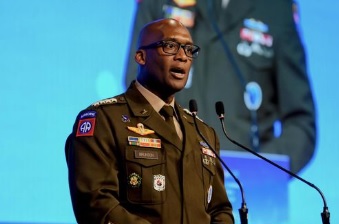
Gen. Xavier Brunson, commander of U.S. Forces Korea, had a different view. He called South Korea a “dagger” aimed right at the Chinese Communist Party (CCP).
Regime leadership in Beijing were not happy.
In remarks widely quoted in the South Korean press, Brunson, observed that the Chinese, when they “look out from the east coast of China, what they see is there’s Korea, the dagger in the heart of Asia.”
Hankyoreh compared Brunson’s remarks to a comment by a 19th century Prussian military adviser to Japan, who said that Korea was “a dagger pointed at the heart of Japan.” That remark was a warning of the danger of China or Russia taking over the Korean peninsula, both of which Japan defeated before ruling Korea as a colony from 1910 to its surrender at the end of World War II in 1945.
Brunson added: “The United States Army is in an enviable position.” American forces in the region, including about 55,000 troops in Japan and 28,500 in Korea, “might act in the theater,” compelling “our adversaries to say, ‘Maybe not today.’ ” Then, “When you look across the region, there’s this woven network of land power that exists across the Pacific.” That’s “the glue that holds it all together.”
Brunson’s view, carried in an interview on the website of the U.S. Army War College’s Strategic Studies Institute, “has upset Beijing just as America’s secretary of war, Pete Hegseth, and other defense ministers are meeting at Singapore for the ‘Shangri-La dialogue’ in which Chinese aggression in the Indo-Pacific assumes fresh urgency,” Donald Kirk noted in a May 29 op-ed for The New York Sun.
South Korea’s Yonhap News quoted a Chinese spokesman in Seoul as saying: “We would also like to tell the U.S. Forces Korea commander that your rhetoric has indeed crossed the line.” The spokesman questioned whether Brunson’s “hostile and aggressive anti-China comments were authorized or intended to challenge the consensus” of the recent summit at which CCP chairman Xi Jinping hosted U.S. President Donald Trump.
That same question is coming up at the Shangri-La dialogue at Singapore, where Hegseth is likely “to reinforce Washington’s Indo-Pacific strategy as competition with China intensifies, particularly over Taiwan,” according to Singapore’s Straits Times. American officials, said the paper, “are also pressing allies and partners to increase defense spending and strengthen deterrence capabilities.”
Hegseth, who will address the event on June 6, “will have to walk a careful line between tough talk about China and President Trump’s desire to get along with Xi,” Kirk wrote.
“One sensitive question is what to say about America’s commitment to Free China for which Trump hesitates to sign off on a $14 billion military aid package,” Kirk added.
Related: Post-Trump peace in the Taiwan Strait hinges on weapons sale decision, May 19, 2026
Xi, at the summit with Trump, warned of “clashes and conflicts” that might break out over Taiwan. Beijing persists in calling Taiwan its own. The communist regime has never ruled the island democracy 90 miles to the west of the Chinese mainland across the Taiwan Straits.
Brunson, in the interview with Tom Spahr, a professor at the Army War college, said he sees America and its East Asia allies, including South Korea, Japan, and the Philippines, as forming “a kill chain” or “kill web” against regional enemies. In a remark that was sure to enrage China, he described Japan as “that shield that’s sort of a backstop” against China’s ambitions in the South China Sea, which China claims as its territory.
“You look at the technological advances that exist in those countries, in particular in Japan and in Korea, the potential for technology to weigh in heavily and change things,” the general said. “ You look at the location of the Philippines where they sit in proximity to, to Taiwan.” The problem, he said, “isn’t an ascendant China.” Rather, “it’s “a more militant or military China that’s the threat.”
2026 Contract With Our Readers

‘Dagger’ comment by U.S. Gen. Brunson triggers Beijing, contradicts Seoul regime added by Editor Two on
View all posts by Editor Two →