
Special to WorldTribune, June 7, 2026 Real World News
Geostrategy-Direct, June 2, 2026
By Richard Fisher
While it appeared to be a significant setback, the May 28 spectacular explosion of Blue Origin’s New Glenn reusable space launch vehicle (SLV) may not result in a huge delay in the Moon Base building plans of the National Aeronautics and Space Administration (NASA).
On May 26, NASA held a major news conference led by Administrator Jared Isaacman to explain the Trump Administration’s aggressive program to create three unmanned “Moon bases” by late 2026, to support the goal of creating a permanent manned Moon base by the early 2030s.
But then on May 28 at about 9 pm at Launch Complex 36 in the Cape Canaveral space launch center, during a routine test firing of the seven BE-4 engines of the Blue Origin Corporation’s large New Glenn reusable SLV, there was a massive explosion (20 percent of the power of the 15 kiloton Hiroshima bomb) destroying the SLV and causing significant damage to the $1 billion launch complex.
The immediate casualty was the planned June 4 third launch of New Glenn, deployment of 48 Amazon Leo broadband satellites, and the ability to refine the New Glenn SLV for the planned late 2026 launch of Blue Origin’s Blue Moon Mk 1 Moon lander to start NASA’s Moon Base-1.
But Blue Origin may be able to recover and resume New Glenn launches by the end of this year.
In a June 1 statement on the Blue Origin web page, Chief Executive Officer Dave Limp stated, “We will fly again before the end of this year,” after noting:
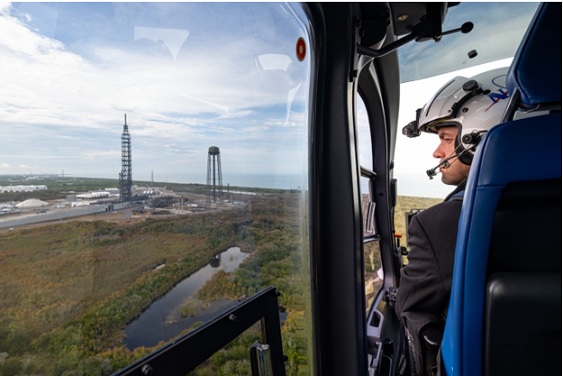
“The propellant farm, oxygen, liquid hydrogen and LNG tanks are all in good shape. This is good luck because these are very long lead items. The water tower is also good. The big support tower is damaged, but it can be repaired in place rather than torn down and replaced.”
CEO Limp also mentioned a decision to reduce complexity, moving from a horizontal-to-vertical launch system that places complex stresses on the payload, to a less stressful vertical assembly for the launcher.
This would be the optimal outcome for Blue Origin and NASA’s desire for an early Blue Moon Mk1 unmanned mission to the lunar surface, to prove the lander’s technology and pave the way for the larger manned Blue Moon Mk2 lander.
There has been much interest in the possibility of using the SpaceX Falcon Super Heavy SLV, that could loft up to 21.8 tons to the Moon, which may just accommodate the 21.35-ton weight of the Blue Moon Mk1 lunar lander.
Full Report . . . . Current Edition . . . . Subscription Information

How massive New Glenn explosion impacts NASA’s Moon base plans added by Editor Two on
View all posts by Editor Two →