
by WorldTribune Staff, July 16, 2026 Non-AI Real World News
Iran’s Islamic Revolutionary Guard Corps (IRGC) is not only the country’s most powerful military force, it also holds enormous influence over policy decisions.
The IRGC, which is a designated terrorist organization by the United States, functions as a state within a state. It shapes domestic politics, dictates foreign policy, and runs massive parts of the economy.
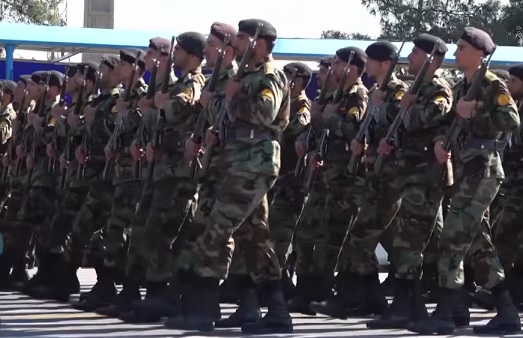
On Wednesday, President Donald Trump was asked by Fox Business if he would consider eliminating the IRGC as the Untied States did with the ISIS terror group.
“You came to the conclusion that you couldn’t negotiate with the IRGC,” Fox Business correspondent Edward Lawrence said. “Does that mean that you might wipe them out like you did ISIS?”
“Yeah, it does,” Trump said. “We’ll see what’s happening.”
Trump’s comments suggest the U.S. could target the IRGC as an institution rather than limit its operations to missile batteries, air defenses, and naval assets. The IRGC, which answers directly to Iran’s supreme leader, oversees much of the country’s missile program and controls powerful military, intelligence, and economic networks.
The United States designated the IRGC a foreign terrorist organization during Trump’s first term.
“Trump’s refusal to rule out targeting the IRGC came as his administration intensified pressure on the organization beyond the battlefield,” The Epoch Times reported on Thursday.
Following Iran’s continued attacks on commercial shipping vessels in the Strait of Hormuz, the U.S. Treasury Department on Wednesday imposed fresh sanctions targeting what it described as a global procurement network supplying weapons and logistical support to the IRGC.
According to the Treasury, the network relied on aviation companies, transport firms, financial intermediaries, and travel coordinators to conceal the IRGC’s role in overseas procurement operations.
“President Trump has been clear that Iran must denuclearize,” Treasury Secretary Scott Bessent said in a statement. “Treasury will continue to target and disrupt the illicit procurement networks that fund Iran’s weapons programs and war machine.”
The renewed American strikes on Iran ordered by Trump reached deeper into Iran early Thursday, with Iranian state media reporting attacks in areas around Teheran for the first time in the latest round of fighting.
Iranian outlets also reported strikes in the provinces of Semnan, Hamedan, Hormozgan, Khuzestan, Lorestan, Markazi, and Sistan and Baluchistan, indicating a widening target set.
According to U.S. Central Command (CENTCOM), American forces completed a second wave of strikes late July 15 after launching attacks earlier in the day against Greater Tunb Island, a strategically important position near the Strait of Hormuz, the key maritime shipping lane that Iran has been choking off.
CENTCOM said U.S. forces struck command centers, air-defense systems, missile and drone capabilities, and coastal surveillance facilities “to further degrade Iran’s ability to threaten innocent mariners crewing commercial vessels transiting the Strait of Hormuz.”
The military said precision munitions were also used against targets in Bandar Abbas, Iran’s principal naval hub on the Persian Gulf.
The latest operations followed a morning assault that lasted roughly 90 minutes and targeted Iranian defense and missile positions on Greater Tunb Island.
Greater Tunb is considered a strategic point in the Strait of Hormuz and forms part of a network of islands that includes Abu Musa, Lesser Tunb, Qeshm, Larak, Hormuz, and Sirri. According to Israeli security officials who spoke to Epoch Magazine Israel, this network constitutes Iran’s “defensive arc” around Hormuz.
Separately, the U.S. military said it disabled a Curacao-flagged oil tanker heading toward Kharg Island, Iran’s main oil-export terminal, after the vessel allegedly ignored repeated warnings and attempted to breach a renewed American naval blockade.
According to CENTCOM, a U.S. aircraft fired Hellfire missiles into the ship’s smokestack, leaving the vessel unable to continue its voyage.
The United States reimposed the blockade after Iranian attacks on commercial shipping earlier this month reignited hostilities and effectively collapsed a memorandum of understanding signed by Washington and Teheran in June.
Freedom Rocks! Until It Is Gone

Should Iran’s IRGC go the way of ISIS? Yes, says President Trump added by Editor Two on
View all posts by Editor Two →