
by WorldTribune Staff, August 23, 2026 Non-AI Real World News
In an effort to clamp down on Chinese supply lines that continue to flow into North America, the Trump Administration has refused to extend the United States-Mexico-Canada Agreement (USMCA) during its mandatory six-year joint review.
The Trump White House’s move acts as maximum leverage to force Canada and Mexico to sever ties with Chinese manufacturing and investment.
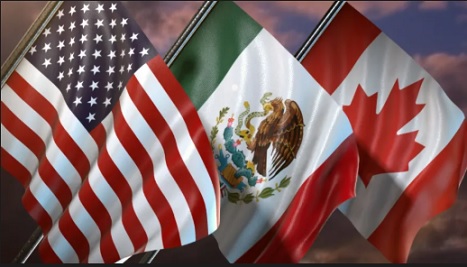 The administration’s primary objective, analysts say, is to build a tighter economic perimeter around North America, eliminating loopholes that allow non-market economies to use U.S. neighbors as a backdoor.
By declining to confirm a standard 16-year renewal of the USMCA, the U.S. has triggered an annual review process that sets a 10-year countdown toward the pact’s potential expiration in 2036.
A top concern is Chinese manufacturers routing cheap products through Mexico or Canada for minor relabeling before exporting them tariff-free to the United States.
The White House released a 25-page report detailing how this “transshipment scam” evades billions in customs duties.
“Canada and Mexico are violating the spirit — and potentially the letter — of USMCA by enabling China to penetrate North American supply chains and circumvent U.S. trade barriers,” noted Miles Yu, professor at the U.S. Naval Academy and senior fellow at the Hudson Institute.
“USMCA is a binding treaty, not a suggestion. Especially, its Rules of Origin and Labor Value Content provisions were designed precisely to prevent this kind of backdoor access.
Led by U.S. Trade Representative Jamieson Greer, the White House is demanding drastically higher regional value content requirements, particularly for automotive components and steel.
This trade push aligns with a separate directive issued by President Donald Trump tightening defense supply chain waiver rules. It forces contractors to aggressively map out lower tiers of the industrial base and phase out all Chinese-sourced critical minerals or software.
Carney calls closer economic integration with China a matter of Canadian sovereignty,” Yu wrote.
“Sovereignty, however, does not mean freedom to ignore treaty obligations while exporting the consequences to American workers and industry. If Canada and Mexico want the benefits of USMCA, they must enforce its rules — and shut China’s back door into the U.S. market.”
Ma Xue, associate fellow at the Institute of American Studies, China Institutes of Contemporary International Relations, noted in a July 2026 analysis that, “from Washington’s perspective, Mexico—currently the largest trading partner of the U.S.— has increasingly become a key transit hub for Chinese auto parts and finished vehicles entering the North American market. As a result, U.S. policymakers argue that the existing provisions of the agreement contain security vulnerabilities that are inadequately addressed.”
Article 32.10 of the USMCA—the provision restricting free trade agreements with non-market countries—stipulates that if any party to the agreement concludes a free trade agreement with a non-market economy, either of the other two parties may, upon six months’ notice, withdraw from the trilateral agreement and replace it with bilateral arrangements. Although this provision formally applies to all three parties, it was widely understood to be aimed primarily at Canada, which at the time was advancing the possibility of negotiating a free trade agreement with China.
Xue noted that the current USMCA review “is expected to introduce new China-related restrictions across four areas: labor enforcement, rules of origin, economic security coordination and external tariff alignment. Taken together, these measures are intended to substantially narrow the scope for Chinese capital, goods and technology to access the North American market.”
Xue concluded:
None of the parties appears intent on erecting a comprehensive trade barrier that would sever economic ties with China. Instead, the anticipated regulatory adjustments are likely to follow a targeted and selective approach, imposing differentiated market access requirements in five sensitive areas: automobiles and parts, the power battery supply chain, strategically critical minerals, next-generation telecommunications infrastructure and foreign investments with national security implications. The objective is to narrow the scope of China’s industrial presence in North America through calibrated regulatory controls, not to bring China-North America economic and trade relations to a halt.
In the longer term, if the current review results in an updated and extended USMCA, the United States, Mexico and Canada are likely to build a coordinated regulatory framework based on a unified set of trade rules, aligning their approaches to both the movement of goods and cross-border investment. By supporting mechanisms such as rules-of-origin verification, coordinated foreign investment screening and harmonized tariff measures, the three countries will seek to further restrict channels through which Chinese goods and capital enter the U.S. market via Mexico and Canada.
Against this backdrop, the USMCA will likely evolve beyond a conventional regional free trade agreement into an institutional framework that reinforces the bloc-based reorganization and regional fragmentation of global supply chains. In doing so, it could significantly reshape the pattern of economic and trade relations between North America and China.
Freedom Rocks! Until It Is Gone

Trump White House tightens restrictions on China supply lines in USMCA review added by Editor Two on
View all posts by Editor Two →