
Special to WorldTribune.com
 By John J. Metzler, October 30, 2026
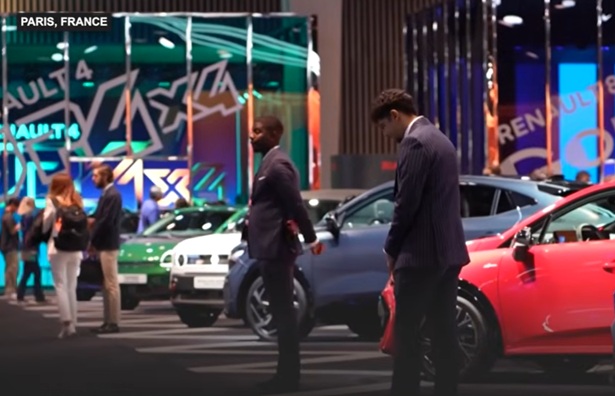
PARIS — There was a strong east wind blowing through the recent Paris Motor Show, the biennial showcase for the European car market.
Among expected marques such as Citroen, Peugeot, VW and Mercedes, nearly 25 Chinese electric automakers from LI Auto to Geely and Zeekr nudged their way onto central stage at the pivotal Porte de Versailles event.
Days earlier arriving at Paris Charles de Gaulle Airport, I was greeted by advertising posters with Daniel Craig, aka James Bond, who serves a Brand Ambassador for Denza autos, a luxury Plug-in electric car company. Denza is a joint venture between China’s BYD Auto and Germany’s Mercedes-Benz.
No this wasn’t jet lag but a jolting reality shock.
Chinese electric cars made their debut in 2006 when the Great Wall brand appeared in a crowded stage; Today about 25 of the 60 major exhibitors were electric marques from China. That’s double the number from 2024.
The Chinese electric car industry is on the march into a fragmented and sometimes struggling European auto marketplace where iconic French brands like Citroen, Renault and Peugeot are under serious market pressures.
EU passenger car production has fallen by nearly 2.6 million units since 2019, a 19 percent drop.
Covid-19 restrictions, a changing demography and a powerful “green movement” has led many buyers away from gasoline cars. China is profiting from this, despite piecemeal European Union efforts at tariffs to block the wave.
Mercedes had a show stopper exhibit of elegance and class with a full line of passenger cars and SUVs. Equally it has revived its tiny Smart Car, built in China for a reasonable price to reenter the European market. Volvo on the other hand is partnering with China’s high end LYNK offering a very classy looking trio of selections stressing the Swedish-connection and a strong in- place network of established European sales and repair facilities.
Volkswagen’s CEO Oliver Blume urged France and Germany to strengthen cooperation to meet serious competitive pressure from Chinese automakers.
But is the legendary European Union regulatory structure up to the serious onslaught?
“Chinese-built EVs are gaining market share in the EU, passing 20 percent of total EV sales in 2026, equivalent to over 5 percent of total vehicle sales,” according to Bruegel an economic Brussels-based think tank. I adds: “More than half of these EVs were western-branded automobiles made in China.” That’s true of Denza and LYNK for example reflecting ties to Daimler-Benz and Volvo.
In October 2024, the EU introduced duties ranging from 7.8 percent to 35.3 percent on Chinese-produced automobiles. In the U.S., the Trump Administration has been focused on effectively blocking Chinese vehicle imports via tariffs and legitimate national security concerns.
The European Commission is drafting the Industrial Accelerator Act, which would tie public incentives to at least 70% EU-sourced components. For example, some cars and batteries are produced in the EU by Asian firms. Hungary hosts a $5 billion a BYD EV assembly plant as well as an $8 billion Chinese battery cell production line. South Korea’s Samsung battery cell production is Hungarian-based while Poland hosts a $3.5 billion LG-Energy battery cell plant.
Amid the growing Chinese presence, there’s a bright spot for the French; The iconic Citroen 2CV the small but beloved deux Chevaux, long out of production, is being revived with an electric version which was one of the European stars of the show. The European makers from VW to Skoda, Mercedes to Audi and even Opel have their electric models and often at affordable prices.
But the perception that Chinese cars entering the European market are inexpensive and shoddy competitors to established European brands is misleading. The Chinese are looking to the SUV and luxury car market, again reflecting Denza and AITO.
Admittedly some of these cars seem on par with European models from Mercedes, Audi and Volvo. AITO is the world’s No.1 Chinese luxury automotive maker to make it to the top 10 global luxury automotive brands list. AITO is expected to enter the European market in 2027.
But there’s a bigger picture and indeed market concern. China’s industrial policy has targeted Europe with both affordable and high-tech market selections. This becomes a competitive challenge as well as national security concern given the implications of job losses, plant closings and outclassed technology for the once vibrant European auto industry.
There’s a looming lesson too for the American auto industry. China’s road to a respected auto industry, and not copycat cars, underscores Beijing’s state-centered policies by using the economic wedge of market competition. It’s in the national interest of both Washington and the Europeans to realize this challenge before it’s far too late.
John J. Metzler is a United Nations correspondent covering diplomatic and defense issues. He is the author of Divided Dynamism the Diplomacy of Separated Nations: Germany, Korea, China (2014). [See pre-2011 Archives]
Support Free Press Foundation

China dominates Paris Motor Show with eye to electric European market added by Editor One on
View all posts by Editor One →