
FPI / January 1, 2026
By Richard Fisher
The Chinese Communist Party (CCP) and its People’s Liberation Army (PLA) held two days of surprise large scale joint-force coercive military exercises surrounding Taiwan on Dec. 29, 2025 and Dec. 30, even though the PLA Eastern Theater Command on Dec. 28 had stated the exercises would not start until Dec. 30.
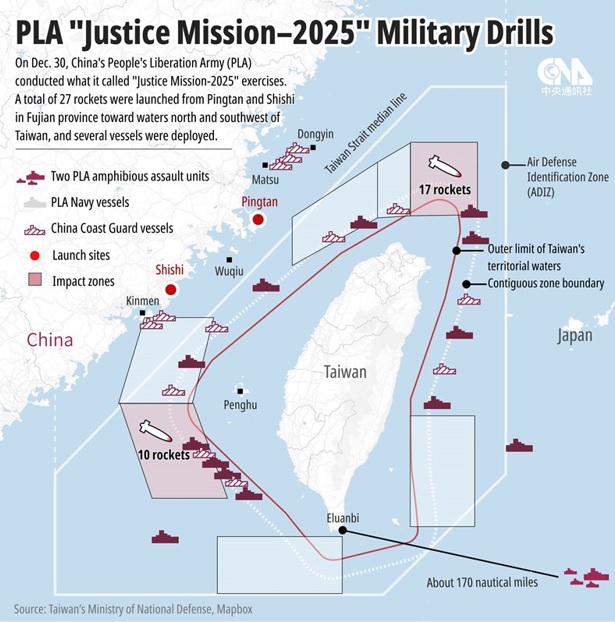
In announcing its “Justice Mission 2025” exercise, PLA Eastern Theater Command spokesman Senior Col. Shi Yi said, “It is a stern warning against ‘Taiwan independence’ separatist forces, and it is a legitimate and necessary action to safeguard China’s sovereignty and national unity.”
But the real purpose of Justice Mission 2025 was to coerce the democratic government on Taiwan to surrender its freedom and to coerce from defending Taiwan, the governments of Japan and the United States, which on Dec. 17 had announced its largest ever $11.1 billion arms sales package for Taiwan.
To demonstrate CCP fury, the Justice Mission 2025 exercises were intended to show that the PLA could impose a surprise blockade of Taiwan, generate a massive surprise combined arms military operations closer to Taiwan, exploit holiday season distraction in Washington, and conduct operations in the harsh weather of December.
The areas of operation targeted Taiwan’s key ports of Keelung and Taipei in the North, Kaohsiung in the South and Hualien on the East Coast and also blocked potential U.S. and Japanese forces coming from the North and South.
Given the adverse weather and rough seas around Taiwan in the month of December, generating such an exercise also demonstrated that the PLA would not be deterred by the weather from initiating major military operations against Taiwan.
The South China Morning Post reported on Dec. 29:
“Major General Meng Xiangqing, who specialises in national security at the PLA’s National Defence University, told China Military Bugle, a social media account run by the PLA’s media centre, that the PLA had ‘plenty of strategic options to punish independence forces in Taiwan and to deter the US…And they can turn the exercise into a war at any time.’”
Day One, Dec. 29: At the end of Dec. 29 the Taiwan Ministry of National Defense revealed that the PLA had send 130sentcraft, unmanned aircraft and three surveillance balloons around Taiwan.
Chinese state media revealed these aircraft included: Xian H-6K bombers armed with 400km range YJ-22 supersonic anti-ship missiles; Shenyang J-16 4+ generation strike fighters armed with the 200km range PL-15 air to air missile; J-10C 4+gen strike fighters; Xian YY-20 heavy aerial refueling aircraft; and Tengden TB-001 long-range unmanned combat aircraft (UCAVs).
In addition, Dec. 29 saw the deployment of 14 PLA Navy warships and 8 “official ships,” most likely PLA Coast Guard ships, that operated around the island.
For the first time in these exercises, the PLA Navy deployed one of its four Type-075 landing helicopter dock (LHD) amphibious assault ships, as well as a Type-055 cruiser and smaller Type-054A frigates.
The PLA revealed on Chinese social media that the PLA Coast Guard had sent ships to sail around Taiwan’s offshore islands of Matsu and Wuqui and that large PLA Coast Guard ships had sailed around Taiwan’s East Coast, to encircle the island.
Full Report . . . . Current Edition . . . . Subscription Information

With surprise exercise surrounding Taiwan, China telegraphs coercion to Japan, USA added by Editor Two on
View all posts by Editor Two →