
Analysis by WorldTribune Staff, March 11, 2026 Real World News
Apparently, you can’t drain the Swamp if the Swamp doesn’t let you.
As he began his second term in January of last year, President Donald Trump and his Department of Government Efficiency (DOGE) called for massive spending cuts.
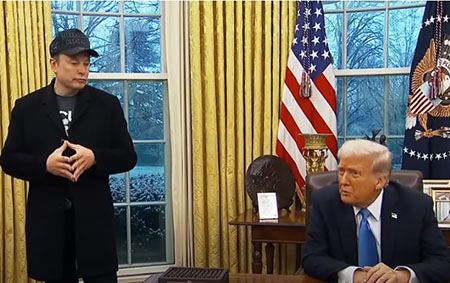
Like President Ronald Reagan, Trump vowed to eliminate the Department of Education. It’s still there.
Remember when Elon Musk said he could slash $2 trillion from the federal government’s budget (which, by the way, is expected to total $7.4 trillion this year)? Musk later downgraded his goal to $1 trillion, but it was still some major Swamp draining.
As Congress finished with most of the fiscal 2026 budget bills it became clear most of those cuts were not made, according to an analysis by The Washington Times.
“Lawmakers took Mr. Trump’s proposals big and small — such as slashing the Education Department, eliminating the Ryan White AIDS program and nixing the Council on Homelessness — and junked them, keeping taxpayer money flowing nearly across the board,” Stephen Dinan wrote for the Times last month.
Dinan noted that the Times sampled 30 of the programs Trump proposed slashing or eliminating in his 2026 budget.
“Only one of the 30 was eliminated. Of the remaining 29, just two were cut by more than half of their previous funding levels,” Dinan wrote.
The Education Department was not eliminated. The department’s budget for fiscal year 2024 was approximately $268 billion, representing roughly 4% of total federal spending,
On March 20, 2025, Trump signed an executive order directing the secretary of education to “facilitate the closure of the Department of Education and return authority over education to the States and local communities”. But the department can’t be closed without the approval of Congress.
Dominik Lett, a budget analyst at the Cato Institute, noted that Congress “largely rejected the discretionary spending cuts President Trump proposed in 2025.”
Bills just approved for 2026 actually increase spending from 2025, and “while some agencies saw modest trims, most funding was held flat or increased,” Lett said.
So what was DOGE’s real tally?
Jessica Riedl, a budget expert at the Brookings Institution, figures it was about $20 billion in actual cuts.
“Some of that was from small changes in public education and woke spending, but most came from cuts to international funding,” Dinan noted.
Riedl said the DOGE-inspired cuts could reach $40 billion annually, but that depends on how the federal buyouts play out. If those positions are refilled or agencies end up paying contractors to perform the same roles, then the savings would be constrained.
The bigger fight was always going to be getting Congress to approve the cuts and write them into law.
In that regard, Dinan noted, “Trump has been nearly shut out.”
In May, the White House submitted a list of about 150 areas and programs it wanted to be slashed or eliminated. They ranged from $17 billion to be cut from the National Institutes of Health and eliminating the $4 billion Low Income Home Energy Assistance Program, to smaller cuts such as shuttering the $17-million-a-year Denali Commission and the $1.65 million that flowed last year to the Office of Navajo and Hopi Indian Relocation.
The Times reviewed 30 of those programs and found that Congress didn’t significantly increase spending for any of them, which could be considered a win for Trump, but it rarely embraced the extent of the cuts the president wanted.
2026 Contract With Our Readers

Swamp drains DOGE: Education Dept. alive and well, Congress increases spending overall added by Editor Two on
View all posts by Editor Two →