
by WorldTribune Staff, May 13, 2026 Non-AI Real World News
As President Donald Trump prepared to meet with Xi Jinping in China, a top ally of Iran, the U.S. continued its blockade of Iranian ports.
U.S. Central Command (CENTCOM) said that the U.S. military in the month since the blockade was first enforced, has redirected 65 commercial vessels and disabled four ships.
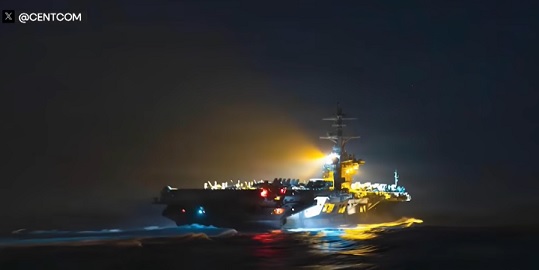
“USS Abraham Lincoln (CVN 72) continues operations in the Arabian Sea, including enforcement of the U.S. blockade against Iran,” CENTCOM said in a May 12 post on X.
In a May 8 post on X, CENTCOM said that the blockade remains “fully in effect.”
Speaking to reporters outside the White House before departing for China, Trump said that while he will have a “long talk” with Xi about the Iran war, he does not see an absolute need for Beijing’s assistance to resolve the conflict.
“I don’t think we need any help with Iran. We’ll win it one way or the other. We’ll win it peacefully or otherwise,” Trump said.
CENTCOM said in a May 8 statement that the USS George H.W. Bush disabled two Iranian tankers that were attempting to enter one of Iran’s ports located on the Gulf of Oman. The two vessels were disabled after U.S. forces fired munitions into the ships’ smokestacks.
On May 6, the USS Abraham Lincoln blockaded another Iranian vessel after firing multiple rounds from a 20mm cannon gun that disabled the tanker’s rudder.
“U.S. forces in the Middle East remain committed to full enforcement of the blockade of vessels entering or leaving Iran,” said CENTCOM Commander Adm. Brad Cooper. “Our highly trained men and women in uniform are doing incredible work.”
The United States has deployed more than 15,000 troops, more than 200 aircraft, and 20-plus warships to execute the mission.
The naval blockade is cutting off Iran’s ability to ship around $139 million in crude oil daily, according to an April 13 post by the Foundation for Defense of Democracies. The export of petrochemicals, minerals, and metals is also affected.
Meanwhile, U.S. Energy Secretary Chris Wright warned Wednesday that Iran is “frighteningly close” to developing weapons-grade enriched uranium.
Wright told the Senate Armed Services Committee that Iran’s enriched uranium, which Trump intends to confiscate, puts the Iranian regime just weeks away from the nuclear weapons threshold.
“They are a small number of weeks away to enrich that to weapons-grade uranium. There’s still a weaponization process that happens after that, but they’re quite close,” Wright said.
Special envoy Steve Witkoff publicly claimed that Iran has boasted about having enough 60% enriched uranium, which if enriched to 90%, would be enough to make 11 nuclear bombs. Getting to 60% enrichment is a much larger technical leap than the jump from 60% to 90%, which is weapons-grade enrichment, top nuclear experts have claimed.
Vice President JD Vance on Wednesday said there has been progress in peace talks with Iran.
“I think that we are making progress. The fundamental question is, do we make enough progress that we satisfy the president’s red line? And the red line is very simple. He needs to feel confident that we’ve put a number of protections in place such that Iran will never have a nuclear weapon,” Vance told reporters.
“I think that we’ve made a lot of progress since we left Pakistan. I thought we made some progress in Pakistan, but we’ve made more since then,” Vance added. “The president has set us off on the diplomatic pathway for now, and that’s what I’m focused on.”
2026 Contract With Our Readers

U.S. still enforcing blockade as Trump meets Xi; 69 ships excluded added by Editor Two on
View all posts by Editor Two →