
Special to WorldTribune, May 22, 2026 Real World News
Geostrategy-Direct, May 19, 2026
By Richard Fisher
Perhaps the most important clash between President Donald Trump and Chinese Communist Party (CCP) leader Xi Jinping during the recent May 13-15, 2026 summit in Beijing was over the issue of the future of Taiwan.
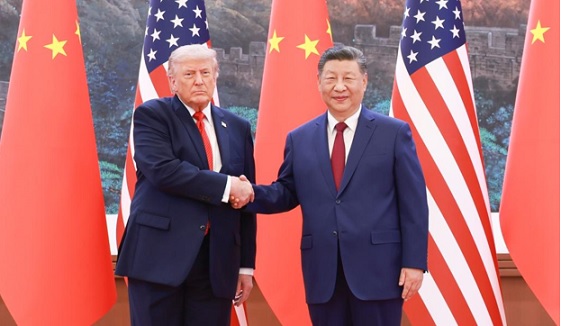
During their first private meeting, Xi Jinping’s high stress on disagreements over Taiwan was not new; in a revealing comment to Fox News’ Bret Baier broadcast on May 15, Trump said of Xi, military action and Taiwan:
“It’s always been his most important thing, from the day, I knew him years ago. I’ve known him now 11 years, 12 years. It’s always been the biggest thing for him, Taiwan. Now, with me, I don’t think they will do anything [militarily] when I’m here. When I’m not here, I think they might, to be honest with you.”
But while the Chinese side likely has always strongly stressed its opposition to all manner of U.S. support for Taiwan during all previous U.S.-China summits, in a May 14 interview with NBC News, Secretary of State Marco Rubio made clear the U.S. listens, but then moves on to other issues, saying:
“Yeah, U.S. policy on the issue of Taiwan is unchanged as of today, and as of the meeting that we had here today, it was raised. They always raise it on their side. We always make clear our position, and we move on to the other topics. We know where they stand, and I think they know where we stand.”
However, in what was a very new development, on May 14 the Chinese side threatened publicly that disagreement over Taiwan could lead to war, with Ministry of Foreign Affairs Spokesman Mao Ning posting o “X” on May 14:
“President Xi stressed to President Trump that the Taiwan question is the most important issue in China-US relations… If it is handled properly, the bilateral relationship will enjoy overall stability. Otherwise, the two countries will have clashes and even conflicts, putting the entire relationship in great jeopardy. ‘Taiwan independence’ and cross-Strait peace are as irreconcilable as fire and water…Safeguarding peace and stability across the Taiwan Strait is the biggest common denominator between China and the US.”
It is not yet known whether CCP leaders have made threats of war in private during previous summits, but the CCP has been trying to take over Taiwan ever since Chiang Kai-shek and his Kuomintang (KMT) government fled to the island after losing the CCP’s revolution 1949.
This goal that has intensified with Taiwan’s evolution into a full democracy with overwhelming popular support, creating a current stark day-night political-cultural contrast with CCP dictatorships.
This increasing contrast, in turn, has ramped up CCP fears for the political legitimacy of its increasingly harsh dictatorship, and as the CCP has rejected all thought of real reform since the 1989 Tiananmen Massacre, it has created as political excuse for invading Taiwan, criminalizing Taiwan’s democracy as the pursuit of “Taiwan Independence.”
But Taiwanese have been practical, refusing to elect leaders who push for de jure “Taiwan Independence” while grudgingly accepting their “de facto” independence from China as long as it does not give the CCP an excuse to attack.
But under the false claim that Taiwan is pursuing de jure Independence, the CCP has justified spending 35 years building up its People’s Liberation Army (PLA) for an eventual blockade and invasion of the now raucously democratic island.
Since 2017 the PLA has built up to conducting daily military operations year-around in the area surrounding Taiwan; The PLA conducted a record 3,764 incursions into Taiwan’s Air Defense Identification Zone (ADIZ) in 2025, representing a 22.4% increase from 2024, while the PLA now regularly practices amphibious invasions of the island.
Furthermore, likely for many decades and largely in secret, a large collection of CPP bureaucrats, PLA planners and Chinese academics has been devising plans regarding how China can absorb Taiwan and over the course of generations, destroy its democratic-cultural identity.
Full Report . . . . Current Edition . . . . Subscription Information

Post-Trump peace in the Taiwan Strait hinges on weapons sale decision added by Editor Two on
View all posts by Editor Two →