
Special to WorldTribune.com
 By John J. Metzler, June 3, 2026
There’s been a subtle but overlooked shift in the bloody war between Russia and Ukraine.
Despite grueling causalities and losses on both sides in the fighting, the Kremlin leadership has been able to keep the worst effects of the conflict away from key populations in cities such as Moscow and St. Petersburg.
But with the advent of lethal drones, Russia is facing economic losses and military raids deep in the vastness of the Motherland. While many of these attacks can been airbrushed out of a controlled media, President Vladimir Putin was taking no chances with an embarrassing draw-down of the traditional military parade in Moscow’s Red Square, Russia’s spiritual and political heart.
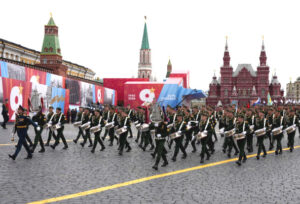
In early May, Vladimir Putin conceded it would be too dangerous to hold the traditional high profile Victory Day celebrations in Red Square given the clear and present danger of Ukrainian drone attacks.
Thus, the holiest political day of the year for Russia, and the former Soviet Union, May 8 Victory Day commemorating the WWII defeat of Nazi Germany, proceeded without the usual massed columns of tanks, missiles and military hardware which Russia likes to flaunt.
Though the parade passed peacefully, and Putin reveled in historical fantasies, there was another missing event.
Would there be a large Russian Spring military offensive into Ukraine?
Time can be slipping, May is now past and it appears most Russian attacks are focused on air raids and missile attacks into Ukraine.
Russia launched 90 long-range missiles and 600 drones during recent attacks across Ukraine but centered in Kyiv, the capital. Many civilians died in the wanton attacks.
Then Moscow warned foreign diplomats to vacate their embassies given the impending danger. The threats were obvious. The UN Human Rights Office verifies that more civilians were killed or injured in Ukraine during the first four months of 2026 than during the same period in 2025. The office verified 815 civilian deaths and 4,174 injuries between January and April.
Addressing an Emergency UN Security Council meeting, Sec. Gen. Antonio Guterres warned that the intensifying conflict risked spiraling “out of control” and faced the dangers of miscalculation and “unknown and unintended consequences.”
Earlier in a plaintive bid, UN High Commissioner for Human Rights Volker Türk called on both sides to return to negotiations. “I strongly urge restraint. Resume negotiations and end the suffering,” he said.
The most recent flareup in fighting followed an alleged Ukrainian drone attack in Russian-occupied Ukraine on a school dormitory where at least 21 students were killed.
Russia’s UN Amb. Vassily Nebenzia claimed that on May 22, Ukrainian forces struck a school in Starobilsk, killing 21 people and injuring 44 others. He added such attacks “did not go unpunished,” as Moscow promptly launched a massive missile attack against Ukrainian command centers and air bases, but also civilian targets.
Ukraine’s envoy rejected the Russia’s “so-called incident in Starobilsk” as a collapsing propaganda narrative.
American Deputy-Amb. Tammy Bruce moreover called the recent missile attacks on Kyiv as “an inexplicable, dangerous and barbaric escalation.” She called for an immediate and comprehensive ceasefire as a step towards a durable peace, she warned that the alternative is “escalating violence that will spiral out of control.”
The war, a macabre meat grinder for both sides has seen a staggering 1.3 million Russian casualties! Lethal Ukrainian drones are decimating Russian units even before they reach the front lines to fight.
“Russia cannot win this war on the battlefield. In 2026, it is losing faster than ever, no territorial gains, even increasing reports on net losses, staggering rate of military casualties and equipment destroyed,” said Latvia’s UN Amb. Sanita Pavļuta-Deslandes. She added, Russia has turned itself into “the ultimate architect of its own economic, intellectual and societal decline,” while escalating Moscow’s long-standing narrative of victimhood, lies and conspiracies.
Latvia’s Envoy stated caustically, “It is time to accept that the Russian empire is in the past. And nothing will bring it back.”
There’s still no long overdue cease-fire. Momentum has stalled and moreover been sidetracked too by the Iran war. And let’s not forget the UN Security Council has been deadlocked for over a decade between Russia/China interests and Western aligned members.
Has Ukraine beaten the Russians at their own game? Or will Putin make a last-ditch military gamble in June?
Either way, Sec. Gen. Guterres added, “This trajectory must change,” he stressed, calling for urgent de-escalation, a full and unconditional ceasefire and renewed diplomacy. “The responsibility is clear, the time for peace is now,” begged the UN Secretary General. But is anybody listening?
John J. Metzler is a United Nations correspondent covering diplomatic and defense issues. He is the author of Divided Dynamism the Diplomacy of Separated Nations: Germany, Korea, China (2014). [See pre-2011 Archives]

Victory Day at Red Square droned into submission this year; Will Putin blink? added by Editor One on
View all posts by Editor One →