
WorldTribune, July 3, 2026 250 Years of Freedom — 10
Commentary by David Morgan
This nation was officially born in July of 1776 when 56 men huddled around a table and signed The Declaration of Independence, probably the most significant historical document ever created.
Their ages ranged from 26 to 70. Edward Rutledge from South Carolina was the youngest at 26 and Ben Franklin from Pennsylvania was the oldest.
Almost all of these signatures came with a heavy price tag!
Five were captured by the British, twelve had their homes ransacked and burned, four had sons killed or captured and nine fought and were killed.
Almost all took massive financial hits.
And by that same winter, things were looking bleak.
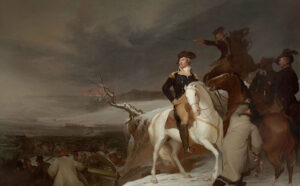
It was cold, brutally cold on Christmas eve in 1776. The men were shivering in the snowy, windy storm. Some had no shoes and faced frostbite. The temperature had hit 20 degrees. Large chunks of Ice were flowing down the river as Gen. George Washinton’s small army waited at night to cross the Delaware River from Pennsylvania into Trenton.
A diary of an unknown officer written at 6:00 pm recorded:
The regiments have had their evening parade, but instead of returning to their quarters are marching toward the ferry. It is fearfully cold and raw and a snow-storm setting in. The wind is northeast and beats in the faces of the men. It will be a terrible night for the soldiers who have no shoes. Some of them have tied old rags around their feet; others are barefoot, but I have not heard a man complain. They are ready to suffer any hardship and die rather than give up their liberty.
Maj. John Wilkinson noted some men left red spots in the snow behind them …“blood from the feet of the men who wore broken shoes.”
It was dark enough so that the Hessian army on the other side couldn’t see them. But Washington wanted to get the crossing done as quickly as possible so the army – now just 2,400 men – could march into Trenton before daybreak at around 5:00am. They were crossing about 10 miles north from where they would need to march to attack. At this point the river is about 1,000 feet wide, and the water depth is from 5.5 feet to 7.5 feet.The ferry boats were 40-50 feet long and as wide as 12 feet. The bottoms were flat and they were propelled along the river by men pulling on a series of cables that reached over the water and poles that were used to push the ferries along. The artillery was also moved on these flatboats.
Ever since August, Washington had been on the defensive as the British troops kept closing in from first Boston and the New York. But now, in spite of everything, Washington had decided he was going on the offensive. Nearly all accounts of Washington’s Crossing indicate that the storm grew even worse around 11:00 pm when heavy snow started to fall.
Another unknown officer wrote:
I am writing in the ferry house. The troops are all over, and the boats have gone back for the artillery. We are three hours behind the set time. Glover’s men have had a hard time to force the boats through the floating ice with the snow drifting in their faces. I never have seen Washington so determined as he is now. He stands on the bank of the river, wrapped in his cloak, superintending the landing of his troops. He is calm and collected, but very determined. The storm is changing to sleet, and cuts like a knife. The last cannon is being landed, and we are ready to mount our horses.
After many hours and several failed crossings by other troop and artillery carriers, of which there were supposed to be three, a clandestine, successful attack was carried out by Washington.
It became known as the Battle of Trenton and was a turning point in the American Revolutionary War that very likely saved the Continental Army and the United States from defeat.
It is all these historical moments that all Americans need to learn about and to understand. These men were willing to give their all and to fight for their freedom; it was not just being handed to them on a silver platter. What we have, and are able to enjoy, we owe to men like these. We must not hand it over for warm platitudes, free rent and food coupons without grasping what was sacrificed for us.
So long as we remember to appeal to the “Supreme Judge of the world” for the blessing of our intentions and actions and ask for the “protection of divine Providence” moving forward, then we should, like others before us, pledge to each other our lives, fortunes and sacred honor.
Staying unvanquished is no easy task and wraps its arms around us each and every day. Let us never forget what has been given and done for us.
250 Years of Freedom Is At Risk

Unvanquished since 1776: A new nation reversed its fortunes in a bitter winter storm added by Editor One on
View all posts by Editor One →