
by WorldTribune Staff, August 24, 2026 Non-AI Real World News
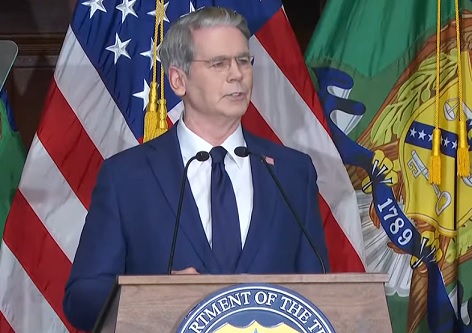
Vowing to target Iran’s financial interests on a global scale, U.S. Treasury Secretary Scott Bessent said on Aug. 23 that an “economic D-Day” is coming for the Islamic Republic.
“We are now entering the endgame,” Bessent said. “At dawn begins an economic D-Day — the single greatest financial offensive ever marshaled against an adversary.”
U.S. sanctions are expected to most directly affect China, the end customer for as much as 90 percent of Iran’s oil sales. Other countries liable to be affected include Turkey, Iraq, Syria, Pakistan, and Afghanistan, all of which buy Iranian oil or natural gas.
While the American blockade has been largely effective in shutting down new seaborne oil shipments from Iran, an estimated 80 million barrels of oil are estimated to already be at sea — much of it aboard a so-called “shadow fleet” of mostly older, unregulated tankers — according to the Kpler tracking service quoted by Reuters.
Trump said of the planned new sanctions: “Oil smuggling, swap lines, cash transfers, exchange houses, ship registries, front companies — It all needs to stop NOW. You know who you are.”
Bessent said President Donald Trump has created the conditions for the United States to use all of its authority and tools to sever Teheran’s financial lifelines and completely isolate the world’s top state sponsor of terrorism.
“The Islamic Republic has subsisted by dressing extortion as security guarantees,” he said. “Under President Trump, that era is over. And those who fear the danger of defying Teheran ought not to discount the cost of testing Washington.”
In a post on Truth Social, Trump warned the U.S. will penalize countries that offer “any type of lifeline” to Teheran. “This will be an ECONOMIC D-DAY, and we need all of our Allies to stand with the United States of America to isolate, and defeat, the Iran threat,” he wrote.
The Trump Administration’s effort expands secondary sanctions to five areas Bessent described as critical Iranian lifelines: digital assets, technology, gold, aviation, and shipping.
At the same time, the Treasury Department’s Office of Foreign Assets Control is sanctioning more than 60 individuals, entities, and vessels accused of helping Teheran generate oil revenue, obtain nuclear and missile technology, and conduct cyber operations.
Bessent said Treasury has mapped the networks Iran uses to smuggle oil and evade existing sanctions and will now move systematically against them.
“Beginning today, the actions of Treasury and other agencies will tighten the noose and block every potential source of revenue that funds the IRGC and the Iranian regime,” he said. “There will be no minimal breathing space for the regime to rebuild its capacity to inflict terror against America and the world.”
Bessent said countries that cooperate with Washington could benefit from closer economic ties with the U.S., while those continuing to support Teheran will face mounting isolation.
“Those who stand with the United States will reap the rewards of our partnership,” he said. “Those who tether themselves to the Iranian regime should expect to share in the isolation of a withering regime.”
Bessent described Monday’s measures as the beginning rather than the culmination of the administration’s financial offensive.
“This is a sustained campaign to collapse every last option for Iran,” he said. “Economic engagement of any kind with this murderous regime will expose those responsible to the full reach of American power.”
Secretary of Iran’s Supreme National Security Council Mohsen Rezaee threatened on social media that if Iran is targeted for economic isolation, it will block oil shipments through the Persian Gulf and the Strait of Hormuz, and “regard any country’s participation in or support for America’s economic war against the Iranian people as an act of war.”
250 Years of Freedom Is At Risk

Bessent announces ‘economic D-Day’ is coming for Iran added by Editor Two on
View all posts by Editor Two →