
Analysis by WorldTribune Staff, November 11, 2026 — Real World News
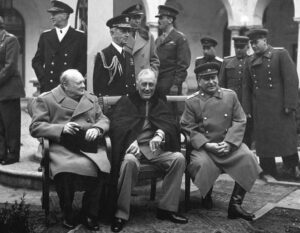
The significance of U.S. President Donald Trump, Chinese Communist Party leader Xi Jinping, and Russian leader Vladimir Putin meeting on the margins of the APEC Summit in Shenzhen, China next week has been compared to the 1945 Yalta Conference between President Franklin Roosevelt, Joseph Stalin and Winston Churchill.
The circumstances 81 years after Yalta between World War II and the looming Cold War are much different. Trump and Putin would be the only two non-communists at the table. Xi’s hesitation about the meeting is likely based on his fears that the days of the Chinese Communist Party, like his own, are numbered.
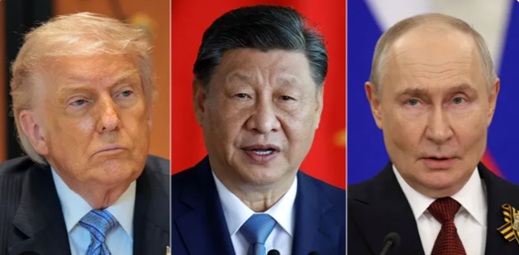
In 1945, the original Big Three were allies who had collectively defeated a common enemy as a global ideological showdown loomed. Today, the U.S., Russia, and China are locked in intense economic, technological, and proxy rivalry if not open warfare.
Powerful corporate, financial and ideological forces have vested interests in such conflict which is after all the status quo. But Trump a Christian and a businessman has pressed for an end to the horrific loss of life in the Russia-Ukraine war and for a markets-based solution to conflicts in the Middle East and the Far East.
Geostrategy-Direct.com reported on Oct. 27:
U.S. President Trump has expressed openness to a three-way summit in China with Chinese Communist Party leader Xi Jinping and Russian leader Vladimir Putin focused on nuclear disarmament. The talks could also address a range of other issues with impact on the global balance of power including the ongoing conflicts in the Middle East and Ukraine in which all three powers play key roles.
U.S. Secretary of State Marco Rubio stated that the U.S. will keep trying to convince a reluctant Beijing to participate in a trilateral nuclear control deal, though the U.S. cannot compel China to join.
Reports indicate that Washington and Beijing are facing deep disagreements over the format and agenda of next week’s meeting.
However the real agenda might be off the official record. There are indications that Trump and Putin, known for their anti-globalist views, were pushing for the meeting while Xi Jinping resisted.
The conventional analysis holds that the Shenzhen summit will be structured merely to manage immediate economic friction and establish basic diplomatic baselines rather than permanently dismantle the world’s deep-seated geopolitical divides.
“We’ll talk a lot of things, including denuclearization,” Trump has said.
Until now, Xi has declared denuclearization is off the table since America and Russia each have more than 5,000 nuclear warheads while China is far behind with upwards of 600 but narrowing the gap rapidly. In fact, Xi has yet to formally endorse what should be the first ever gathering of the American, Russian, and Chinese leaders.
Writing for The New York Sun on Nov. 11, columnist Donald Kirk noted: “It’s far from certain, however, that Messrs. Trump, Putin and Xi can come to terms on anything beyond vaguely hopeful statements considering how far apart they are on the issue that Mr. Trump wants most to discuss.”
However, the fact that Trump, Xi, and Putin could “be sitting down in the same room for even a few minutes of palaver is a good sign,” Kirk added. “Hopes for peace, however slim, range from Ukraine, where the Russians keep killing people with drones, to the Middle East, where Russia and China support Iran with arms and other forms of assistance against America and Israel, to northeast Asia, where North Korea’s leader, Kim Jong-Un, supported by Russia and China, threatens South Korea, Japan, and far-off America with nuclear weapons.”
Putin has reportedly been pushing hardest for the sideline summit.
To the dismay of Ukraine’s leader, Volodymyr Zelenskyy, Putin agreed on shipping diesel oil to America while Washington removed onerous sanctions imposed during Putin’s war against Ukraine.
The Russian national newspaper Izvestia, once a Soviet mouthpiece, still a voice for the government, reported “a senior Russian diplomat” as saying a trilateral summit “could give a strong positive boost to international affairs” while focusing “on the most pressing challenges.” While “the key parameters of the talks have yet to be clarified,” the paper said, “experts argue that a potential summit could help find common ground on Ukraine as well.”
Izvestia quoted assorted “experts” from universities and government institutes, all of whom spoke glowingly of all the trilateral could accomplish.
“Although the economy is APEC’s absolute priority, political issues will clearly take center stage this time around,” said the deputy director of the Moscow Pedagogical State University’s History and Politics Institute, Vladimir Shapovalov. “The planned meeting between the leaders of Russia, the United States, and China will be the summit’s main event.” Ukraine, Izvestia reported him as saying, “would be one of the issues that Putin, Trump and Xi may discuss.”
Comparisons with the conference at Yalta 81 years ago were irresistible even if the issues are very different and the chances of real agreement seem minimal
“The prospect of a meeting between Donald Trump, Vladimir Putin and Xi Jinping on the sidelines of the APEC summit in Shenzhen on 18–19 November 2026 has revived debate over a ‘new Yalta,’ ” said the Italian think tank Istituto Analisi Relazioni Internazionali. “The three powers possess military capabilities far exceeding those of most states, but they do not form a homogeneous bloc.”
Analysts point to additional factors keeping the ongoing “forever wars” alive:
• The power of asymmetric resistance: In conflicts ranging from Ukraine to the Middle East, smaller or less conventional forces have repeatedly proven capable of inflicting severe, prolonged costs on global superpowers. Force alone no longer dictates total submission, and smaller nations will fiercely resist any attempt by the Big Three to carve up territories over their heads.
• Entrenched local dynamics: The ongoing war in Ukraine and the conflict involving Iran are driven by deep regional, ideological, and historical friction. These cannot be dissolved by a top-down decree from external leaders. For instance, while U.S.-mediated trilateral talks in Abu Dhabi recently yielded prisoner swaps between Russia and Ukraine, they exposed just how far apart the actual combatants remain on foundational issues like territorial sovereignty and postwar security guarantees.
• Alienation of allies: A unilateral approach by the Big Three bypasses traditional democratic alliances and middle powers. Without broader international buy-in, any framework established in Shenzhen would lack the systemic legitimacy required to enforce global stability or sustain a rules-based order.
250 Years of Freedom Is At Risk

Could next week’s meeting of this century’s ‘Big Three’ end divide-and-conquer ‘forever wars’? added by Editor Two on
View all posts by Editor Two →