
Special to WorldTribune, March 19, 2026 Real World News
[Excerpted from an analysis by Richard Fisher in the current edition of Geostrategy-Direct.com
As of March 16, the Chinese Ministry of Foreign Affairs had not yet responded to Trump’s March 15 Hormuz Straits escort suggestion, telling the Financial Times, “China should help too because China gets 90% of its oil from the Straits.”
The idea to include China’s navy in keeping the Straits open may have been logical to Trump inasmuch as he is frustrated with the reluctance of major U.S. allies to join this effort.
But there is a more central question regarding China and the Iran War:
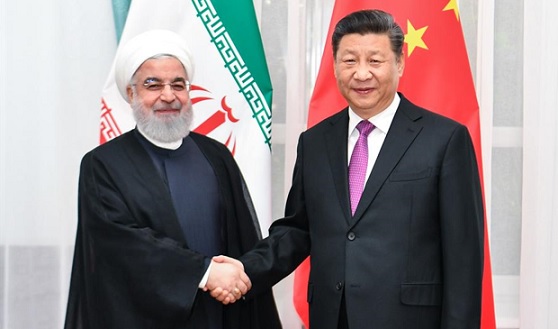
As part of the Trump-Xi summit, Trump should be explaining to Xi why it is just and necessary for China to be paying post-Iran War “reparations,” or more specifically, paying for the reconstruction of Iran and for the damages that Iran’s missile and drone attacks have caused in the Gulf States and Israel.
In a rare criticism of Iran on March 11, Chinese Ministry of Foreign Affairs spokesman Guo Jaikun stated, “China does not go along with attacks against countries in the Gulf region and condemns indiscriminate attacks against civilians or non-military targets.”
This constituted but a thin crack in the door to China’s vast culpability; On many levels the CCP is the handmaiden of the Iran War.
It has been China’s annual purchases of Iranian oil that has funded Iran’s nuclear weapons and missiles programs that sparked this war.
By unofficial estimates, between 2016 and 2026 China purchased up to $250 billion worth of Iranian oil, that when considering annual Iranian national budgets have come in at $40 to $50 billion, allows for a rough estimation that oil sale revenues from China could account for up to half of annual Iranian government spending.
Without annual oil sales to China, it is questionable whether Iran could have afforded to fund and arm its proxies Hamas, Hizbullah and the Houthis with sophisticated rockets and missiles, and could have afforded to fund much of the Hamas’ horrific October 2023 war against Israel.
Without annual oil sales to China, it may also be questionable whether Iran could have afforded its 30+ year nuclear weapons program.
On March 2, Trump’s Iran negotiations envoy Steve Witkoff told Fox News’s Sean Hannity:
“Both the Iranian negotiators said to us, directly, with, you know, no shame, that they controlled 460 kilograms of 60% [reprocessing strength], and they’re aware that that could make 11 nuclear bombs, and that was the beginning of their negotiating stance.”
It was this brazen disclosure by Iranian officials that helped convince President Trump that a war against Iran was necessary to prevent its radical Mullah dictatorship from acquiring nuclear weapons — that Iran could very well use against Israel and the United States.
Furthermore, without Chinese annual purchases of Iran’s oil, it is unlikely that Iran could have paid for its expansive ballistic missile, cruise missile and long-range loitering attack drone programs.
As of March 14, Iran has launched a total of 1,155 ballistic missiles and 3,285 drones against Israel, the United Arab Emirates (UAE), Saudi Arabia, Jordan, Oatar, Oman, Turkey and Cyprus, with over 1,000 missiles and drones launched at UAE alone.
It is also the case that Iran could not build its ballistic missile and drone arsenals without decades of access to Chinese engineering education, consulting and access to Chinese-made navigation, engine and direct guidance/targeting technology.
It is quite possible to conclude that Iran’s missile terror campaign was paid for by China, built from a wide variety of Chinese-made parts, in some cases fueled by Chinese-made rocket fuel precursors and then guided/targeted by China’s large constellation of surveillance and navigation satellites.
This begins the case as to why China should be paying reparations to support the reconstruction of Iran, Israel and the Gulf States damaged by Iran’s missile strikes.
Though any final estimate can only be determined after the conclusion of Iran War hostilities, some estimates hold that reconstruction costs for Iran and the Gulf States could run from $500 billion to $1 trillion.
But instead of simply handing Xi Jinping a bill, why not invite him to join President Trump’s Board of Peace with an initial $100 billion donation?
As the Board’s first Chairman, Trump would have great influence on how the reconstruction donations are spent, and China would only have one vote on the Board for major funding decisions.
This would be a just outcome for China as the handmaiden of the Iran War.
2026 Contract With Our Readers

Analyst: Why U.S. should demand reparations from China, ‘handmaiden of Iran War’ added by Editor Two on
View all posts by Editor Two →