
Special to WorldTribune.com
Analysis by Gregory R. Copley, Editor, GIS/Defense & Foreign Affairs, May 18, 2022
Neither President Donald Trump nor PRC President Xi Jinping were anything less than cynical — or pragmatic — over the purposes and outcome of the Trump State Visit to the PRC on May 13-16, 2026.
It was designed to stabilize the PRC’s process of rapid and chaotic decline (economically and politically) and give a sense of calm to the United States’ aggressive striving for a restructured global strategic environment.
The long-term strategic balance between the PRC and United States did not appear to be significantly altered by the visit.
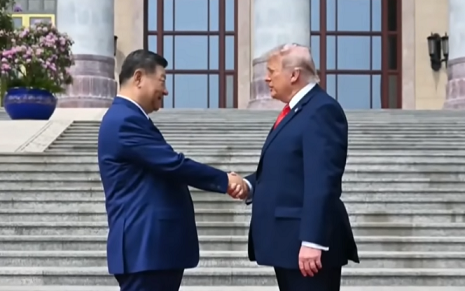
The decline in strategic confidence by Beijing by 2026 was measured to some degree by the fact that the Communist Party of China (CCP) knew well enough the peril of giving Presdent Trump anything other than the highest possible diplomatic show, far greater than it gives its supposed main ally, Russia, and far removed from the deliberate insult shown to then-U.S. President Barack Obama on his G20 visit to Beijing in September 2016.
The visit was a symbolic and superficial affair — “full of sound and fury and signifying nothing” — but it achieved several things which Trump and Xi were seeking, mainly including a period of stability at a crucial time for each of them. The return to calm in bilateral trade and investment relations could be regarded as tactical and emotional in the perception of the situation.
But that does not mean that the visit lacked very real and important outcomes for each of the principals involved, well separated from the public gaze. Most areas of accords — deals — reached were well discussed in the open media. These were ephemeral and helped calm the markets.
From an external, global perspective, the result of the visit was not the fact that Trump accepted a PRC invitation for a State Visit. It was not perceived as Trump paying homage to Beijing and recognizing its near-peer status. Rather, it was perceived — in the over-arching global view — as Trump being received as a conquering figure. That was the unfortunate byproduct for Xi Jinping, but it was worth the sacrifice to achieve the domestic success he sought.
Xi needed to be perceived, in the midst of the CCP’s “civil war” for power, as the only figure who could deal with, and achieve concessions from, the United States during this second term of President Trump. His power has been eroded steadily in recent years, and the PRC economy itself has essentially collapsed. It still has a formidable economy — perhaps it really is still the number two economic power in the world, but there are even doubts about that — but it is unstable and has triggered structural problems of an existential nature. Xi must navigate that, and it appeared that the Trump visit gave him some respite within the power struggle.
Trump also won some short-term concessions from the PRC: the commitment for Beijing to buy additional U.S. farm products (mainly soybeans), and manufactures (mainly Boeing airliners, and additional computer chips), and to be able to invest in the U.S. economy. This would have a positive impact on U.S. domestic economic-political audiences in the run-up to the U.S. mid-term congressional elections in November 2026.
More importantly, Trump served notice that the U.S. would not tolerate continued PRC support for the Iranian clerical government during the present crisis, but would still be able to obtain energy imports from Iran, and also, potentially, from the U.S.
Overall, however, one of the main underlying accomplishments, as far as President Trump was concerned, was a “round two” of the U.S. strategy to separate Beijing from Moscow, with “round one” having been undertaken by then U.S. President Richard Nixon in 1972. This time, however, Moscow would not be able to seriously retaliate against the U.S. coup de main.
If Trump’s approach has been to break up the older perceptions of stable alliances and the balance of power, a process of “divide and confuse”, then the U.S.-PRC move could well be seen as a further step in dividing and minimizing his opponents. Certainly, President Trump left Beijing — essentially “discarding” Beijing through some deliberate irritants designed to show that he was “moving on” — and never looked back.
The varying comments post-visit by Trump and some of his key officials reinforced the traditional Washington approach to East Asia: strategic ambiguity. Trump raised the speculation as to whether it was worth traveling 9,500 miles to the First Island Chain to fight the PRC over Taiwan.
But this also gave U.S. allies such as Japan, South Korea, the Philippines, Australia, and New Zealand equal pause as to whether the U.S. would travel that same distance to honor security agreements with them.
This would have given great alarm not only to Taiwan, but all other U.S. allies in the Indo-Pacific, if stated only a few years ago. Today, those allies are making separate plans to manage their strategic space to a greater degree without the U.S., even though they do not expect the U.S. to abandon East Asia or the Indo-Pacific linkage areas.
Again, although the overarching strategic trajectory in the bilateral competition seems largely unchanged, with the PRC in continued decline and the U.S. in continued strategic consolidation, Trump’s secretiveness in his planning and actions has become far more accepted by the traditional U.S. allies.

Beijing Summit stabilized strategic trajectory of rising Trump order, declining CCP added by Editor One on
View all posts by Editor One →