
Analysis by WorldTribune Staff, April 12, 2026 Non-AI Real World News
President Donald Trump has consistently opposed “blank check” funding for Ukraine, stating in 2025 that the U.S. would focus on stopping the conflict.
Media have slammed Trump for supposedly shutting off the funding spigot to Ukraine. That spigot, however, was permanently turned on by Congress during the Biden-Harris regime and America is still sending Volodymyr Zelensky billions in “obligated funds.”
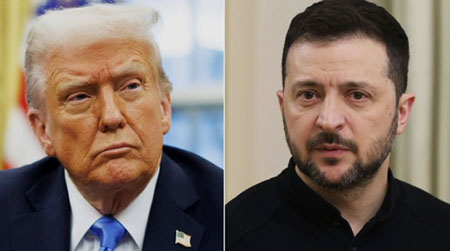
Meanwhile, the same media routinely heap praise on Europe for continuing to have Zelensky’s back while those same European nations are addicted to Russian energy and are sending billions which are funding Vladimir Putin’s war machine.
The official interagency oversight reporting from the Special Inspector General for Operation Atlantic Resolve, initiated in 2014 in the Obama Administration following Russia’s invasion of Crimea, shows the Ukraine-response funding pipeline rose from $83.4 billion as of December 31, 2024, to $89.5 billion by March 31, 2025, then to $94 billion by June 30, 2025, and finally to $109.5 billion as of December 31, 2025.
That is $26.1 billion disbursed in the first year of the second Trump term.
“Let that number settle for a moment. Twenty-six billion dollars. In a single year. Under a president whom the world’s press corps has relentlessly characterized as having abandoned Ukraine,” Alexander Muse noted in an April 10 analysis.
Congress appropriated $174.2 billion through five Ukraine supplemental appropriation acts spanning fiscal years 2022 through 2024. When additional annual appropriations and other supplemental acts are included, the total rises to $187.7 billion allocated for Operation Atlantic Resolve and the broader Ukraine response.
“These appropriations were not designed as single-year expenditures,” Muse noted. “They carry defined periods of availability for obligation, often ranging from 1 to 3 years or marked ‘until expended,’ which means that the money was always going to flow well beyond the date of enactment. The funds were obligated, the contracts were signed, and the disbursement machinery was set in motion before Trump ever returned to the Oval Office.”
Meanwhile, European nations continue to send billions to the Russian regime for energy.
Since Russia’s full-scale invasion of Ukraine in February 2022, EU countries have paid more than €200 billion ($232 billion) to Russia for energy supplies.
The Centre for Research on Energy and Clean Air documented that EU imports of Russian fossil fuels in the third year of the invasion, amounting to €21.9 billion, actually surpassed the €18.7 billion in financial aid the EU sent to Ukraine over the same period.
“President Trump pointed this out in his March 2025 address to Congress, noting that Europe had spent more buying Russian oil and gas than it had spent defending Ukraine. The fact-checkers quibbled with the margins, but the essential point was sound,” Muse wrote.
The EU remains the largest buyer of Russian liquefied natural gas and pipeline gas.
As for U.S. taxpayer funds going to Ukraine, Muse noted, “the numbers become truly staggering for anyone who has internalized the fiction that American support has ended.”
As of the most recent official pipeline snapshot, $64.5 billion sits in the “obligated but not yet disbursed” category.
“This is money that has already been committed through contracts and agreements, money that is legally bound to flow,” Muse wrote.
Beyond that, another $7.2 billion remains appropriated but not yet obligated.
“Some additional amounts sit in expired or ‘under review’ status,” Muse added. “The total appropriated universe remains $187.7 billion, and the U.S. government has disbursed only about 58% of it. The remaining 42%, roughly $71.7B, is still working its way through the pipeline.”
Muse continued: “To put it plainly, over the coming months and years, American taxpayers will send Zelensky another $64.5 billion in already-obligated funds. If the war continues and the remaining appropriated-but-unobligated funds are put to use, that figure grows by at least another $7.2 billion. This is not speculative. This is not contingent on new congressional action. This is money that is already in the system, already committed, already on its way.”
Continued funding of the Ukraine war is unpopular with the American public. A December 2025 Economist/YouGov poll documented waning support for military aid to Ukraine, with nearly half of Republicans wanting aid reduced or stopped entirely. A February 2026 Council-Ipsos survey found that Republican support for sending military aid to Ukraine had fallen to 43%, down from 51% the previous year.
“When your base does not want the money flowing, you do not hold press conferences bragging about the billions you are sending,” Muse noted. “The result is a peculiar silence. The administration has no political incentive to trumpet its continued support, and the media has no narrative incentive to acknowledge it because doing so would undermine the story they prefer to tell about American abandonment.”
Americans, Muse added, “deserve to know the truth. Their money is still flowing to Ukraine, in enormous quantities, every single month. The silence surrounding this fact is not an accident. It is a choice, made by leaders on both sides of the Atlantic who find the myth of American abandonment more convenient than the reality of American generosity. But myths, however politically useful, eventually collide with arithmetic. And the arithmetic here is unambiguous.”
As for the EU, Muse wrote: “The next time a European foreign minister stands at a podium and lectures the United States about its obligations to Ukraine, someone should hand him a copy of the Operation Atlantic Resolve pipeline report. And then someone should hand him the CREA data on European energy purchases from Russia. The contrast between the two documents tells you everything you need to know about who is actually paying for Ukraine’s defense, and who is paying for Russia’s war machine, often from the same national treasury.”
2026 Contract With Our Readers

Crazy? U.S. still sending Ukraine billions in ‘obligated funds’; Europe still paying Russia billions added by Editor Two on
View all posts by Editor Two →