
Special to WorldTribune.com
 By John J. Metzler, April 6, 2026
NATO is again in the rhetorical cross hairs as the Trump Administration has called out some European members for not allowing American aircraft transit through U.S. European bases.
Nor have the Europeans rallied to politically help the United States confront Iran’s blockade of the strategic Strait of Hormuz. Washington’s ire is warranted but its reactions are unnecessary.
The high-octane rhetoric across the Atlantic is justified given the fact that some NATO allies such as Spain have not stepped up to their treaty obligation and actually closed their airspace to American warplanes.
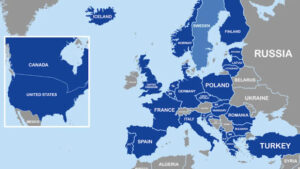
Earlier in the war, Britain’s Prime Minister Kier Starmer tried playing the same card, “This is not our war and we’re not going to get dragged into it” he commented early on by restricting use of British bases to U.S. aircraft which were covered by the NATO alliance.
Needless to say, this did not play well in the White House.
The political fracas raises the obvious questions. President Trump warns the U.S. may leave NATO. The Europeans blink in horror but then the smug disdain of some in their political class emerges and they feel vindicated by confronting Washington.
Enough! The transatlantic trash talk only plays into Moscow’s hands and its Ukraine game plan.
NATO stands for the North Atlantic Treaty Organization, a multinational defense alliance founded by the United States on April 4, 1949, in Washington DC for the defense of Europe against Soviet aggression.
Twelve members including the United States and Canada and ten European states, among them Britain, Belgium, Denmark, France, the Netherlands and Portugal formed the cornerstone of post-WWII collective security.
Yet keep in mind, North Atlantic denotes the waters between Europe and North America but also includes the Baltic, North Sea and the Mediterranean. In other words not the Persian Gulf, not the Indian Ocean nor the Red Sea.
Related — Rubio: ‘Why are we in NATO’ when we can’t use their bases during a military crisis? April 1, 2026
It’s pretty obvious that NATO is known as the Atlantic Alliance and political ties were framed in the mantra of the Transatlantic Alliance.
Following the fall of the Soviet Union in the early 1990’s many “experts” having declared that the West had won the Cold War, then logically asserted with the confidence of fools, “now there’s no need for NATO.” Why do we need such an expensive defensive military alliance for a future without any credible threat of a European war?
Thus, NATO from its comfortable perch in Brussels had to “reinvent itself” to become “relevant” and to seek “new missions out of area” to become NATO 2.0.
The Yugoslav civil war and the Bosnian tragedy was not a NATO operation but a UN peacekeeping mission. But then came Kosovo and Bill Clinton’s golden moment in April 1999 to attack Serbia and carry out an extensive ten-week NATO bombing campaign to deter Belgrade’s ethnic cleansing in Kosovo.
Tragically the September 11th, 2001 terrorist attacks on America jolted the world into refocus.
Soon NATO launched its largest Out of Area operation, an eighteen-year multinational mission in Afghanistan supported by the U.S. and UK and troops from more than a dozen NATO nations.
The Atlantic Alliance is all about collective security. The Treaty’s Article 5 states an attack on one is an attack on all 32 members.
|
Let’s get real. The U.S. founded and nurtured NATO during the dark days of the Cold War. It’s a successful American alliance worth keeping. |
But breaking Islamic Iran’s blockade closing the strategic Strait of Hormuz and reopening the Persian Gulf brings unpredictable military and political consequences.
NATO navies are simply too small. Britain’s once vaunted Royal Navy, still strong enough to support the Falklands War operation in April 1982, has been reduced to less than half the size.
Let’s face it: The 600 ship U.S. Navy of the Reagan era now stands at 292 ships. I’ve long asserted that the U.S. Navy is overextended in its global missions. To use a baseball metaphor, it’s trying to cover three bases with two players.
Protecting oil tankers through armed convoy operations in the Persian Gulf would logically fall to the U.S. Navy, not necessarily NATO. Indeed, the vital Strait of Hormuz carries nearly 90 percent of the petroleum and 83 percent of Liquid natural gas (LNG) destined for India and East Asia. Only a small fraction is now getting through.
NATO probably won’t rise to the occasion in the Persian Gulf, but at the same time has massively upgraded its military spending for European defense in light of the Ukraine war.
But let’s get real. The U.S. founded and nurtured NATO during the dark days of the Cold War.
It’s a successful American alliance worth keeping.
John J. Metzler is a United Nations correspondent covering diplomatic and defense issues. He is the author of Divided Dynamism the Diplomacy of Separated Nations: Germany, Korea, China (2014). [See pre-2011 Archives]
2026 Contract With Our Readers

NATO 2.0 and geopolitical reality: U.S.-nurtured alliance is worth keeping added by Editor One on
View all posts by Editor One →