
Special to WorldTribune.com
 By John J. Metzler, December 12, 2025
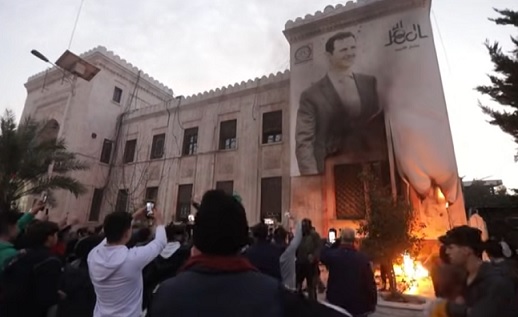
Just one year ago Syria’s brutal and seemingly eternal Assad family dictatorship was toppled.
The long-entrenched Russian backed regime fell in a matter of ten days to a series of lightning offensives by the Islamic Hayat Tahrir al-Sham movement backed by Turkey.
The tyrant was toppled in Damascus, the Assads fled to Moscow, and suffering Syria fell into the shadow of a forgotten conflict.
Nearly fifteen years of brutal civil war and agonizing humanitarian conflict became synonymous with Syria. The chaos kept Syria in the headlines; Now that the fighting has ended and a new regime has come to power in Damascus, the country is largely being overlooked as part of the global conflict fatigue.
That’s a mistake as the tragedy from fourteen years of sectarian civil war and nearly a half century of the Assad’s socialist albeit secular regime had turned the country of 24 million people into a humanitarian disaster now waiting to be rebuilt and socially reborn.
UN Secretary General Antonio Guterres advised, “What lies ahead is far more than a political transition; It is the chance to rebuild shattered communities and heal deep divisions. It is an opportunity to forge a nation.”
Here’s what they still confront despite the guns having mostly fallen silent. More than half the population or 16.5 million people are in need of assistance according to the UN’s OCHA humanitarian agency. Top donors to the relief efforts are the European Commission with $151 million, the U.S. with $116, million and Germany with $70 million.
As much as the physical and human destruction in Gaza have captured the headlines and the sympathy of this generation, just over a decade ago ancient and storied Syrian cities such as Aleppo, Homs and Hama were being pounded into piles of jagged concrete rubble by incessant bombing, fighting between various rebel and usually Islamic factions and Assad’s Russian and Iranian backed militias. Assad’s forces used chemical weapons on its own people and blasted them with artillery barrages and crude “barrel bombs” dropped from helicopters.
According to the UN, at least 580,000 people were killed in the civil war.
Civilian losses were appalling and usually far from the media’s sight. Humanitarian waves of refugees fled the country and then spread throughout Europe most especially to Germany, Sweden and to neighboring Turkey.
In 2015 alone, Germany accepted almost one million Syrians, most of whom are still in the country. Even since the political changes in their homeland a mere, 1,300 Syrians, or 0.1% have returned, according to Germany’s Interior Ministry.
At the end of November there were still at least 4 million Syrian refugees, the largest number being in Turkey, Lebanon and Germany.
Lisa Doughten of the UN Humanitarian affairs told the Security Council: “Despite the enormous needs, this remains a hopeful time for millions of Syrians, as reflected in the growing number of people choosing to return to their homes.” She stressed, “More than 1.2 million refugees have now returned from neighboring countries since last December. More than 1.9 million people who were displaced internally have also returned.”
This is encouraging news but increases the strain and responsibility to deliver humanitarian assistance inside Syria. Ms. Doughten added, “The people of Syria do not want to rely on emergency aid.”
During the civil war, a witches brew of militias often ran amok; Islamic jihadis, Iranian Guards, Kurdish self-protection units. These don’t include the Islamic terrorist groups such as Al Nusra and ISIS, nor the foreign fighters from Western Europe who joined their ranks in solidarity.
The fall of the Assad regime created a major setback for both the Islamic Republic of Iran as well as Russia, both of whom had deep geopolitical stakes in Syria.
Not surprisingly, deadly violence continues along sectarian lines.
The Assads belonged to the minority Alewite sect of Islam; The country’s majority as in most Arab lands are Sunni Islam. This is one fault line and since the fall of the Assad’s, there have been attacks in Latakia and the coastal regions. Equally the Druze minority in the south has fallen prey. Clashes have flared between the new government’s security forces and those loyal to Assad.
Syria’s embattled Christians, an ancient religious community once comprising at least ten percent of the population in places like Aleppo, have widely fled leaving a drastically reduced presence from 1.5 million to nearly 300,000 today.
Syria’s interim President Ahmed al-Sharaa, a former Al-Qaida militant, leads a fragile political transition presumably towards a more tolerant society. In the meantime, Washington has lifted previous economic sanctions in a cautious outreach to the new regime.
Already Syria is becoming one of those “forgotten conflicts.” Let it not be forsaken.
John J. Metzler is a United Nations correspondent covering diplomatic and defense issues. He is the author of Divided Dynamism the Diplomacy of Separated Nations: Germany, Korea, China (2014). [See pre-2011 Archives]

One year after the Assad family left, Syria’s tragic saga is hardly over added by Editor One on
View all posts by Editor One →