
by WorldTribune Staff, April 3, 2026 Non-AI Real World News
America’s first manned mission to the moon since the 1970s, today sets course to swing within about 4,000 miles of the lunar surface on the far side of the Moon before being propelled back to Earth. In addition to NASA’s earlier announcement of plans to use nuclear propulsion to significantly reduce transit times to Mars, the U.S. space program has seized the initiative from China.
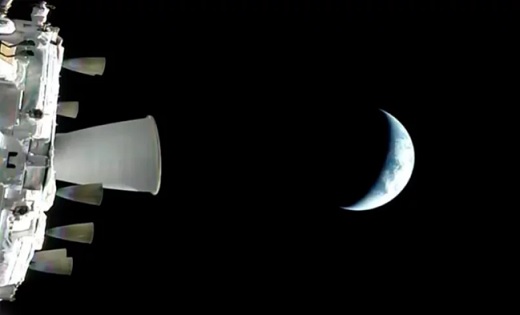
On the Artemis II mission in progress, the next big item on the agenda is an engine burn to send the Orion spacecraft and its four astronauts out of low Earth orbit and toward the Moon.
During his first term, President Donald Trump formally redirected NASA’s focus. He signed Space Policy Directive 1, which aimed to return American astronauts to the lunar surface for the first time since 1972, laying the groundwork for the Artemis program and establishing a foundation for future Mars missions.
The Biden-Harris regime did not stick to the aggressive landing deadline set by Trump.
The four-person crew will not land on the moon. The crew is performing a flyby mission, orbiting the moon to test the Orion capsule’s life-support systems, paving the way for a future lunar landing, planned for the Artemis III or later missions.
The astronauts will swing around the far side of the moon to be propelled back to Earth. NASA says the moon should look to them about the size of a basketball held at arm’s length.
They will come closest to the moon on flight day six with the crew expected to set a record for the farthest anyone has traveled from Earth.
The plan is for the Orion capsule to splash down in the Pacific Ocean on the 10th day of the flight.
NASA has pushed back the date for a lunar landing after scrapping a planned Artemis III mission later this year. The Artemis III phase calls for astronauts to dock in lower-Earth orbit with new moon landers being built by SpaceX and Blue Origin. NASA hopes that mission will take place sometime next year.
NASA is accelerating plans to build a mini-nuclear reactor to deploy to the lunar surface. The space agency has been studying using fission systems to provide power on the moon and eventually Mars. While still being developed, such systems are expected to be relatively small and lightweight while powerful enough to enable “robust operations,” NASA says.
Richard Fisher reported for Geostrategy-Direct.com on March 31 that the United States “fully intends to secure access to the Moon, Mars and to secure access though the Solar System.” He explained the potential of nuclear propulsion to significantly reduce transit times to Mars, making human transport all the more feasible and sustainable:
“Nuclear thermal propulsion uses a nuclear reactor to heat a propellant (usually hydrogen) to very high heat to achieve high thrust and speed, while nuclear electric propulsion also uses a nuclear reactor to generate heat, to ionize a propellant (like Xenon gas) to achieve lower thrust but highly efficient, long-range propulsion.”
Fisher continued:
This message would have the greatest impact in Beijing, as the Chinese Communist Party (CCP) is also seeking to secure a dominant position on the Moon, Mars and then into the Solar System as part of its longstanding ambition to achieve hegemony on Earth and in space.
Since August 2023, the China Aerospace Science and Technology Corporation has been describing its 100-year program to project China’s unmanned and manned presence though the Solar System.
This is why NASA’s announcement of a 2028 nuclear-electric powered mission to Mars is a political coup; It will be the United States that will demonstrate first the potential of nuclear propulsion to significantly reduce transit times to Mars, making human transport all the more feasible and sustainable, and then enabling far more rapid missions to Jupiter and beyond.
The current Artemis II mission can be tracked in real time via NASA’s website (here) or the NASA app (here).
2026 Contract With Our Readers

Orion spacecraft set to exit Earth orbit for Moon; Mars plan called ‘political coup’ vs China added by Editor Two on
View all posts by Editor Two →