
Special to WorldTribune, February 22, 2026 Real World News
By Richard Fisher for Geostrategy-Direct, February 17, 2026
Since 1963, the Munich Security Conference (MSC) has served as an annual meeting ground for European and American foreign policy elites, spanning the Cold War and into the new era of multiple powers, enabling constant European and American debates
The current issue is how to deal with the challenge of the Chinese Communist dictatorship.
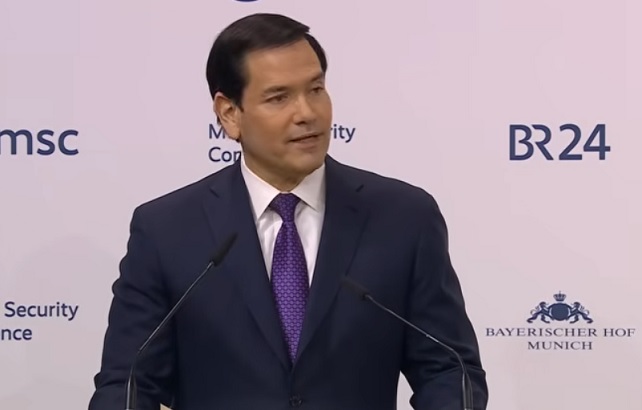
This year’s conference provided a vital contrast between the speeches of U.S. Secretary of State Marco Rubio and Chinese Foreign Minister Wang Yi, in which the latter described a key aspect of China’s attempt to place itself at the center of a new world order, while Rubio offered a principled rejection.
Secretary Rubio spoke first, but it seemed like he had a preview of Wang Yi’s speech which extolled Chinese Communist Party (CCP) leader Xi Jinping’s 2025 “Global Governance Initiative,” in which Xi offered to provide or organize “an overarching operating system” for a new global order.
Wang Yi spent most of his speech explaining and promoting Xi Jinping’s Global Governance Initiative, saying:
“President Xi Jinping proposed the Global Governance Initiative (GGI), and called for following the five principles of sovereign equality, international rule of law, multilateralism, the people-centered approach, and real actions, with a view to jointly building a more just and equitable global governance system… In reforming and improving global governance, the priority is to revitalize the United Nations system… The U.N. is not perfect, but it remains the most universal and authoritative intergovernmental organization in the world… Therefore, what is imperative for us today is to recommit to the founding mission of the U.N., revitalize the leading role of the U.N…”
China offers a basic contradiction: while saying it supports the principle of “sovereignty” and “rule of law,” it undermines and seeks to replace both with some kind of new order to be determined and then, likely, enforced by a United Nations (UN) in which it wields dominant influence.
China uses its veto, its position as second largest funder, to control many U.N. organizations and block democratic voices from the UN to promote Chinese priorities that strengthen Chinese power.
Wang Yi then made a revealing comment:
“We need to make sure that all countries abide by the same set of rules, i.e., the basic norms governing international relations underpinned by the purposes and principles of the U.N. Charter…”
In other words, rules determined by the China-dominated United Nations that serve China’s interests and priorities and that undermine the democracies and their freedom.
It is uncanny that without previewing Wang Yi’s speech — one might assume — and without directly naming the Global Governance Initiative, Secretary Rubio offered both criticism and rejection, saying:
“…we can no longer place the so-called global order above the vital interests of our people and our nations. We do not need to abandon the system of international cooperation we authored, and we don’t need to dismantle the global institutions of the old order that together we built. But these must be reformed. These must be rebuilt.”
Full Report . . . . Current Edition . . . . Subscription Information
Subscribe to Geostrategy-Direct

Rubio in Munich rejected China’s UN-linked Global Governance Initiative added by Editor One on
View all posts by Editor One →