
Analysis by WorldTribune Staff, June 8, 2026 Non-AI Real World News
If China’s state news agency Xinhua is to be believed, and it should not, President Xi Jinping’s visit to resource-rich North Korea on June 8, 2026, is a much bigger event than the recent state visits to Beijing by U.S. President Donald Trump and Russian President Vladimir Putin.
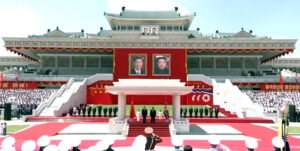
Seoul-based correspondent Donald Kirk notes in a New York Sun report that Xinhua’s coverage of the trip is “far outpacing” its reporting of last month’s high profile visits.
“From the moment that Mr. Kim and his wife, Ri Sol-ju, greeted Mr. Xi and his wife, Peng Liyuan, at the airport, it was evident that China and North Korea both wanted it known that they are on the best of terms.
“At Kim Il-sung Square, named for Mr. Kim’s grandfather, strutting soldiers paraded while shrieking school children waved furiously in a show that mirrored the greeting accorded Russia’s President Putin two years ago.”
Why the sudden interest by China in North Korea, which Xi last visited in 2019 and which according to recent reports is providing its elites a much-improved lifestyle since its enhanced ties with Russia?
Leave it to the Times of India to provide some geopolitical perspective in an analysis titled “Why China is Worried about Kim Jong Un and Russia”:
There is a deeply strategic reason: Beijing is growing increasingly uncomfortable with Pyongyang’s warming ties with Moscow.
Xi’s visit “is driven by China’s desire to weaken the deepening Russia-North Korea alliance while protecting Beijing’s own strategic interests in northeast Asia,” the Times suggested.
Ironically North Korea, which asserts its own ideological superiority over Chinese communists and the former Soviet Union, is dependent on both major powers not only for food and natural gas and but on China in particular for its nuclear weapon and missile technology. Now the bizarre dynastic totalitarian state with the world’s worst human rights record is being wooed by both powerful states.
Related: Staking North Korea’s claim to nuclear power status, Kim called big winner on Sept. 3, September 10, 2025
“Xi is out to prove that China, not Russia, is North Korea’s big brother, and Kim had better not forget it,” Kirk wrote.
Or, as one of the passionate Xinhua reports put it, China “stands ready to work with the DPRK to strengthen the alignment of development strategies and expand practical cooperation in such areas as economy and trade, agriculture, construction, science and technology, as well as health care.”
The problem for Xi is that “North Korea, counting on China for most of its oil and as much as half its food, has long resented its dependence on China, which rescued the North from defeat by American and South Korean forces in the Korean War,” Kirk noted.
So North Korea’s propaganda organ, Rodong Sinmun, was much more matter of fact in its coverage of the Xi visit:
The Korean people ardently welcome Comrade Xi Jinping visiting the DPRK again with the feelings of warm friendship of the fraternal Chinese people.
The report met the effusive Chinese promises of practical cooperation and assistance with the reminder that “Korean revolutionaries,” led by Kim Il-Sung, “helped the Chinese revolution with blood in the arduous anti-Japanese struggle.”
But the other geopolitical wild card involving North Korea, once known as the “hermit kingdom,” is U.S. President Donald Trump who by all account developed a personal bond with the young dictator Kim Jong-Un that survives to this day. One wonders what the two unpredictable leaders said in private conversations about communist China and Xi Jinping.
Freedom Rocks! Until It Is Gone

June 8 in Pyongyang: Rogue state rivalry for the affections of . . . North Korea? added by Editor Two on
View all posts by Editor Two →