
Special to WorldTribune.com
 By John J. Metzler, May 20, 2026
Amid the spectacle and political pageantry in which Beijing so excels, President Donald Trump and his high-powered American business entourage visited China. The trip to the People’s Republic comes amid rising global tensions, continuing trade frictions and disruption of maritime commerce in the Middle East.
But beyond the political choreography, the president’s State Visit focused on three key issues; Taiwan, Trade/and Technology, and the Teheran regime’s illegal blocking of international trade routes.
Interestingly the polemical tone between the U.S. and China, reflected by body language and words between Donald Trump and Xi Jinping, was far less confrontational than a decade ago, and more accepting of a kind of political parity and managed competition between the world’s two largest economies.
Taiwan
Nonetheless China’s Xi put his cards on the table with an expected and brazen assertion that Taiwan “belongs to China” and that the Taiwan issue remains a “red line for China.”
Beijing’s claim that the self-governing and democratic island, run by a totally different government since 1949 than the communists, unquestionably belongs to the People’s Republic, reflects the myopia of those in the Forbidden City.
But for the U.S., Taiwan presents a “red line” issue too.
In the aftermath of WWII and Mao’s communists seizing Mainland China from the Nationalists, American policy has been politically and military supportive of Taiwan’s defense.
Although the Carter Administration switched Washington’s political ties from Taipei to ‘Beijing in 1979 and abrogated the U.S. mutual defense treaty, bi-partisan Congressional majorities in Washington remain strongly supportive of defending Taiwan’s de facto democracy and sovereignty.
Xi’s push for a tough political position on Taiwan in a closed-door meeting, reflects classic PRC Marxist mantra that the self-ruled Chinese island which it views as a renegade province must “return to the Motherland,” or else.
Despite periodic peace initiatives and military coercion, Beijing has never renounced the use of force to bring Taiwan into communist China’s orbit. As importantly, Xi’s Taiwan focus counterbalances China’s economic slowdown and rumblings of political discontent thus offering a nationalist rallying point.
Though Chinese diplomats stressed the issue, the American side stayed silent showing a
quiet determination both not to get into a political fracas over Taiwan’s status, but rather to stay focused that Washington soundly backs democratic Taiwan.
Trump’s silence, by not publicly confronting Xi on Chinese territory, was both polite as well as principled in not having to explain a key East Asian American policy since 1949.
Nonetheless U.S. policy supports the status quo on Taiwan, not any moves towards de jure “independence” for the self-governing island.
Beijing is grudgingly willing to work within that current formula, namely that the Republic of China on Taiwan with its 23 million people, are part of the China issue yet to be resolved. Any semantic tampering with Taiwan’s official title indicating “separatism or independence” would trigger Beijing’s military wrath.
President Trump specifically and unequivocally warned against formal “Taiwan independence.” Taiwan President William Lai stated he’s committed to maintaining the cross-strait “status quo,” and contributing to regional peace and stability.
Ultimately, the United States security commitment to Taiwan, including the current $14 billion in American defensive arms sales, reflects on Washington’s wider geopolitical commitment in East Asia, especially to Japan, South Korea and the Philippines.
Trade/Tech
Trade tensions with the People’s Republic have been a hallmark of both Trump Administrations.
The issue is rooted in massive American trade deficits with China as well as Beijing’s blatant decades old technology theft from the USA, not to mention the de-industrialization of the U.S.
Trump’s classic weapon against China rests on tough trade tariff policies.
Given China being a Surveillance State, allowing the PRC access to the highest caliber AI chip technology would empower the dragon and sustain the regime.
The U.S./China two-way trade deficit in 2016 before the first Trump Administration stood at $347 billion!
In 2025, the deficit with Beijing was cut to $202 billion. Trump lauded agricultural sales which will boost American farmers.
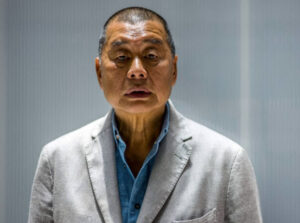
Viewing the Sino/American relationship, Beijing wants to set the paradigm of a reliable partner and managed competition, not the polemical war of confrontational ideas; So why not then release noted political prisoner Jimmy Lai?
Teheran
The Strait of Hormuz remains effectively blocked by the Teheran regime’s illegal closure.
China, whose deep dependence both on Iranian petroleum and access to it faces a bind.
Donald Trump pressed Chairman Xi on opening this chokepoint but failed to get Beijing’s total cooperation.
Xi is on record as calling for the Straits of Hormuz to reopen and equally opposes Teheran transit tolls, but Beijing was not expected to budge on wider American cooperation over Iran.
The game continues.
John J. Metzler is a United Nations correspondent covering diplomatic and defense issues. He is the author of Divided Dynamism the Diplomacy of Separated Nations: Germany, Korea, China (2014). [See pre-2011 Archives]

Trump’s China trip: The three T’s, Iran and Jimmy Lai added by Editor One on
View all posts by Editor One →