
by WorldTribune Staff, December 24, 2025 Real World News
The belief that the Chinese Communist Party (CCP) has transformed into a trustworthy partner on the world stage is pure fantasy, an analyst said.
“Communism is incompatible with a rules-based international order because it rejects the sovereignty of rules. In Beijing’s logic, the party is sovereign, and the law is conditional. Agreements bind others, never itself,” Miles Yu, director of the China Center at the Hudson Institute, wrote for The Washington Times on Tuesday.
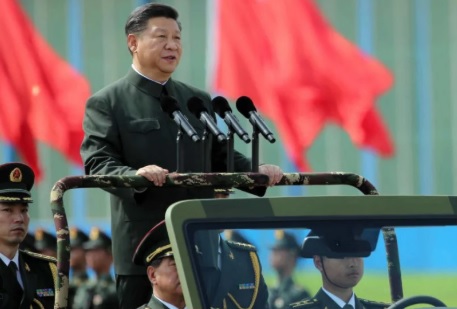
“In Washington, Brussels and several European capitals, there remains a persistent, albeit diminished, belief that the Chinese Communist Party can still be coaxed into a grand bargain — that Beijing can be persuaded to “help” end wars in Ukraine or the Middle East, to stabilize global markets, or to correct the trade imbalances and intellectual property thefts that it has spent decades perfecting,” Yu wrote.
“China, in this telling, is implied not to be a principal source of disorder but an indispensable partner whose cooperation must be patiently cultivated. This belief survives not because it is supported by evidence but because abandoning it would require acknowledging that one of the central assumptions of post-Cold War engagement with a morally and ideologically unredeemable communist government has failed.”
It was foolish to believe, Yu insists, that China would abide by international agreements it signed onto. Capitalizing on the benefits and then violating such agreements is CCP doctrine.
“Once those benefits are secured, the obligations are reinterpreted, diluted and eventually discarded. This is not drift. It is doctrine. China’s accession to the World Trade Organization in 2001 was hailed as a triumph of integration. It was premised on sweeping commitments: market opening, transparency, nondiscrimination, and meaningful limits on state intervention,” Yu wrote.
“Twenty years later, the results speak for themselves. State subsidies dominate entire sectors. The party sits inside firms. Technology transfer is coerced. Regulation remains opaque and political. For China, WTO rules were never intended to discipline the party; they were used to enrich and empower it.”
The same goes for Hong Kong.
“The 1984 Sino-British Joint Declaration was not a vague political statement; it was a binding, registered international treaty guaranteeing autonomy and civil liberties until 2047,” Yu wrote. “Once sovereignty was secured, Beijing declared the agreement obsolete and dismantled Hong Kong’s institutions piece by piece. This was not an unfortunate breach. It was a calculated abandonment.”
Yu continued: “These are not isolated failures. They are a consistent operating method: sign first, benefit immediately, comply selectively, deny accountability indefinitely. Apologists respond with a familiar refrain: All countries violate treaties. This argument is not only false in practice but also evasive in intent.”
The part is placed above all else Under Marxist-Leninist rule.
“Law is subordinate. Treaties are not constraints on power; they are tools to be used against others. When enforcement arises, Beijing does not adjust its behavior. It denies jurisdiction, rewrites obligations or simply refuses to comply,” Yu wrote.
More often than not, the CCP’s violations of international agreements carry no cost.
“Agreements based on goodwill and ambiguity do not restrain communist systems. They reward them,” Yu wrote. “The conclusion is unavoidable. The world must never again take China’s words for granted. Statements, communiques and white papers are not evidence. Behavior is.”

Trust the Chicoms? Violating international agreements is CCP ‘doctrine’ added by Editor Two on
View all posts by Editor Two →