
by WorldTribune Staff, December 28, 2025 Real World News
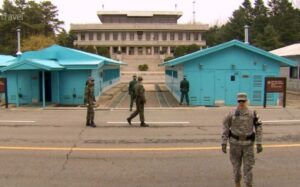
The general in charge of U.S. forces in Korea rejects a move by the administration of leftist South Korean President Lee Jae-Myung to adopt legislation on civilian entry into the demilitarized zone (DMZ).
“We don’t allow that area to become politicized,” Gen. Xavier Brunson said in an interview with the website War on the Rocks. “We signed an agreement,” he said, referring to the armistice. “We have to continue to engage there. What governs our behavior is the armistice.”
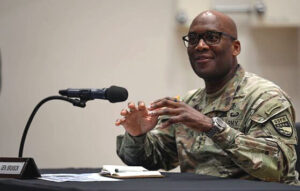
As commander of U.S. Forces Korea, Brunson is responsible for maintaining the armistice between North and South Korea and for the 700,000 troops on the Korean peninsula.
“General Brunson’s remarks were a sharp rejoinder to a bill proposed by members of South Korea’s ruling Democratic Party in a bid to undermine the Korean-American alliance while seeking reconciliation with North Korea,” Donald Kirk wrote in a Dec. 22 analysis for The New York Sun.
Brunson, who was born in Ft. Bragg, near Fayetteville, NC, let his views be known after the UN Command, presumably on his instructions, declared that “civil administration” below the line in the middle of the four-kilometer-wide zone that divides North from South Korea “shall be the responsibility of the commander-in-chief of the United Nations Command.”
Kirk added: “The debate poses a threat to Korean-American relations as long as South Korea’s Democratic Party remains in power under the president, Lee Jae-Myung. Lee has not commented, but party stalwarts in the national assembly see civilian access to the zone as a step on the way to dialogue with North Korea’s leader, Kim Jong-Un.”
South Korean leftist newspaper Hankyoreh wrote: “The general assertion of control over the DMZ by the UNC — which very rarely issues public statements — appeared to come in response to recent movements by lawmakers with the ruling Democratic Party.” The report added that legislators had sponsored a bill “on the peaceful use of the DMZ.”
Veterans of years of military experience along the DMZ strongly oppose the bill and see it as undermining defense of the South where it’s needed most.
The UN commander “would certainly be blamed by many of the same politicians — particularly through the media — if something were to go wrong,” retired American army officer Steve Tharp told the New York Sun. Tharp, who has led numerous tours of both civilians and military people to the DMZ, said that “any meaningful change requires a signed agreement among the relevant parties, which could potentially even include the North Koreans.”
Chun In-Bum, a retired South Korean lieutenant general, stated: “The DMZ is not a park, a museum, or a confidence-building playground,” General Chun wrote in the English-language Korea Times. “ It is the last physical and legal barrier between armistice and war.”
The UN Command, Chun noted, “is not merely a U.S.-led military venture.” Rather, he said, “It is a multinational command established pursuant to United Nations Security Council resolutions. Its authority under the armistice provides part of the international legal foundation for the U.S. and allied military presence in Korea.” Attempts to “sideline or erode the UNC’s role,” he said, “risk introducing ambiguity into deterrence and crisis management.”

U.S. general holds line on access to the DMZ, challenges legislation pushed by South Korea’s Left added by Editor Two on
View all posts by Editor Two →