
FPI / December 1, 2025
By Richard Fisher
China has a habit of not returning American phone calls, but on Nov. 24, 2025, Chinese Communist Party leader Xi Jinping called United States President Donald Trump.
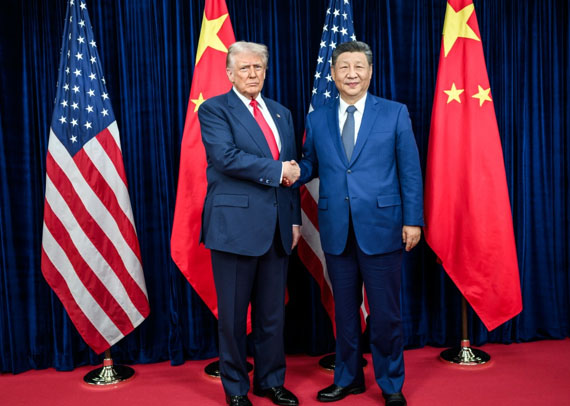
The rarity of Xi deciding to call Trump has to be noted.
On April 1, 2001, when a People’s Liberation Army Navy Air Force (PLANAF) Shenyang J-8II fighter collided with a U.S. Navy EP-3C electronic surveillance aircraft, killing the Chinese pilot and forcing the U.S. aircraft to land at a PLA base on Hainan Island, nobody at the PLA in Beijing would return the urgent calls of U.S. military officials and diplomats.
However, the Chinese account of the conversation shows that Xi was seeking to lay a trap for Trump.
|
Any American acceptance of the idea that Taiwan belongs to China or that its return “is an important part of the post-war international order” is tantamount to a surrender of the U.S. political-military position in Asia, and an abandonment of its military alliances. |
This also about sums up the Chinese government’s attitude toward dialogue: We don’t return your calls and we do not have to engage in any “transparency,” but when we meet you are obliged to listen to our lectures and insults.
Related: China tries but fails to bully Japanese Prime Minister Takaichi Sanae, November 13, 2025
President Trump took the call and posted his assessment on his social media, saying:
“I just had a very good telephone call with President Xi, of China. We discussed many topics including Ukraine/Russia, Fentanyl, Soybeans and other Farm Products, etc…Our relationship with China is extremely strong! This call was a follow up to our highly successful meeting in South Korea, three weeks ago. Since then, there has been significant progress on both sides in keeping our agreements current and accurate. Now we can set our sights on the big picture. To that end, President Xi invited me to visit Beijing in April, which I accepted, and I reciprocated where he will be my guest for a State Visit in the U.S. later in the year. We agreed that it is important that we communicate often, which I look forward to doing. Thank you for your attention to this.”
While Trump has long understood that China is a major challenge and a competitor to the United States, he would also prefer that China and the United States not be at war, so while investing heavily in American strength, he is also careful to cultivate a personal relationship with Xi Jinping.
But as Chinese state media made clear very quickly, Xi had a much different goal in calling Trump, as Xinhua was quick to report:
“Chinese President Xi Jinping on Monday clarified China’s principled position on the Taiwan issue in a telephone call with his U.S. counterpart, Donald Trump. Xi stressed that Taiwan’s return to China is an important part of the post-war international order [emphasis added]. China and the United States once fought side by side against fascism and militarism, Xi noted, adding that at present, they should jointly safeguard the victorious outcomes of World War II.”
First of all, the United States was not allied with the Chinese Communist Party to defeat “fascism and militarism,” the later a Chinese code-word for Japan.
Full Report . . . . Current Edition . . . . Subscription Information

A rarity: Xi called Trump, but his purpose was to set a trap added by Editor Two on
View all posts by Editor Two →