
by WorldTribune Staff, February 1, 2026 Real World News
In his bid to overturn the 34 hush money convictions stemming from the Stormy Daniels case, President Donald Trump has an unlikely legal ally.
Attorney Jed Shugerman, a liberal who twice supported Trump’s impeachment and backed both cases brought against the president by special counsel Jack Smith, has filed an amicus brief in support of overturning Trump’s convictions in the Daniels case.
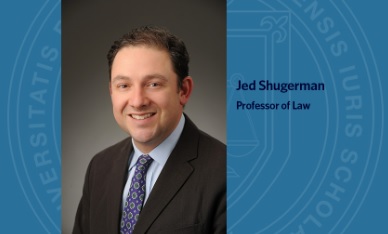 Shugerman, a professor of law at Boston University, argues in an amicus brief filed on Thursday that the convictions secured by Manhattan District Attorney Alvin Bragg should be overturned.
The charges stem from payments totaling some $130,000 that Trump made to Daniels, whose real name is Stephanie Clifford. Trump was convicted by a Manhattan jury and is appealing the case in state and federal court.
Shugerman’s counsel, Steven Rosato — he is petitioning for his client to be allowed onto the case’s docket — writes that “Even if there had been criminal activity in this case, Professor Shugerman firmly believes that this was a case for federal enforcement alone. It is a dangerous precedent for local prosecutors to disregard the law and overreach into federal politics.”
Shugerman told The New York Sun’s A.R. Hoffman that the problems with Bragg’s case “were always there” but that the “district attorney took the problems and made them glaring.” He calls the convictions of Trump “an example of a Pyrrhic victory” and declares that the “sooner this case gets overturned the better.”
Bragg’s state criminal case against Trump trespassed on the prerogatives of federal law, Shugerman argues. While Trump was charged with falsification of business records — a state misdemeanor — those convictions can transform into felonies if they are transacted in the service of a second crime. That second crime was state election interference. As far back as opening statements Shugerman called the case “an embarrassment, in terms of prosecutorial ethics and apparent selectivity.”
Shugerman writes that “the alleged federal election violation was at the core” of Bragg’s case because the case “against President Donald J. Trump was based upon a provision of State law with respect to election to Federal Office, from the start and especially at the finish.” He argues that federal law preempts the state criminal case brought by Bragg against Trump, who was running for the highest federal office in the land.
If, as Shugerman argues, “Congress intended to preempt enforcement of state laws and regulations in the conduct of campaigns for election to federal office,” then Bragg’s reliance on New York’s election law to elevate the charges into felonies was itself unlawful. Shugerman writes that Bragg’s “precise theory, including whether it depended on a violation of New York election law, remained opaque until the reading of the jury instructions” by Judge Juan Merchan.
Hoffman noted: The Second United States Appeals Circuit appears to share Shugerman’s concern with the nature of Bragg’s case. In December it ordered a federal trial court judge, Alvin Hellerstein, 92, to reconsider whether the whole case ought to be heard in a federal forum. Judge Hellerstein has twice ruled that it belongs in state court. The Second Circuit, though, urged him to address ‘whether changes in the State’s theory of prosecution might restore Trump’s purported federal defense’ based on preemption.”
Shugerman contends the “case that ultimately went to the jury had a fundamental … preemption problem,” in that it trespassed on federal terrain. That would violate constitutional bedrock. The Supremacy Clause ordains that federal law, along with the Constitution itself and ratified treaties, “shall be the supreme Law of the Land; and the Judges in every State shall be bound thereby, any thing in the Constitution or Laws of any State to the Contrary notwithstanding.”
2026 Contract With Our Readers

Anti-Trump liberal attorney files amicus brief to overturn conviction in Stormy Daniels case added by Editor Two on
View all posts by Editor Two →