
Analysis by WorldTribune Staff, May 14, 2026 Non-AI Real World News
Who said what, when in Beijing on May 14? Officially and off the record? Is there a body language expert in the house?
The reality is that the United States is the dominant energy power in the world and the sole superpower in terms of economic clout, strategic technology, and a combat-tested military. What’s more it has a president adamant about leveraging that power rather than apologizing for it.
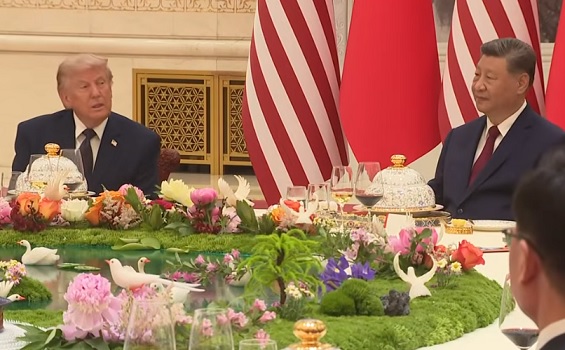
Beyond that, we are left with digital words on rival statements to be regurgitated by talking heads of multiple ethnic persuasions to dramatic effect where possible.
Xi emphasized that Taiwan is the most important issue in China-U.S. relations and, if handled well, could improve overall stability between the two nations, according to China’s readout.
But Xi added that, if the Taiwan issue is handled poorly, the two countries will have “clashes and even conflicts putting the entire relationship in jeopardy.”
The U.S. readout of Trump’s meeting with Xi did not once mention Taiwan, focusing instead on the Iran war and how China can assist in ending it, and described the summit as a “good meeting” regarding economic cooperation and trade.
The White House readout said Xi expressed opposition to the militarization of the Strait of Hormuz, which has been effectively shut down by Iran, sending oil and gas prices soaring.
Xi also said he was interested in buying American oil to lessen China’s dependence on Iranian oil and agreed that Iran can never have a nuclear weapon, according to the White House readout.
Before the meeting began, Trump underscored his standing with Xi, calling him a friend and a “great leader,” adding that he had “such respect” for him.
“A stable bilateral relationship is good for the world,” Xi said through a translator. “We should be partners, not rivals.”
Meanwhile, U.S. Energy Secretary Chris Wright on Thursday said in congressional testimony that the U.S. is producing nuclear weapons at levels not seen since the Cold War as officials warned of a rapidly expanding Chinese arsenal and growing nuclear threats from Iran.
“Today, NNSA is delivering more new nuclear weapons and plutonium pits than at any time since the Cold War,” Wright said during a Senate Armed Services Committee hearing, describing what he called a broader U.S. “nuclear renaissance.”
The ramp-up comes as China undertakes what lawmakers described as an “unprecedented” expansion of its nuclear forces, raising concerns in Washington about a shifting global balance of power.
Senate Armed Services Committee Chairman Roger Wicker warned that the communist regime in Beijing is moving beyond a minimum deterrence posture and building a far larger and more sophisticated nuclear arsenal under Xi.
“China’s building a far larger and more sophisticated nuclear force,” Wicker said, pointing to the rapid construction of hundreds of new missile silos, expanded mobile missile systems, ballistic missile submarines, and investments in long-range bombers. “All of these measures flow from and to a strategy designed to surpass the United States in the coming decade. Deterrence is expensive, but this is a competition we cannot afford to lose.”
Wright told the committee the Trump Administration is responding with a sweeping modernization effort, with seven major warhead programs underway simultaneously to ensure each leg of the nuclear triad remains operational.
“Thanks to President Trump’s leadership, America’s nuclear renaissance is here,” Wright said. “It is absolutely essential that every power in the world believes and understands that the United States has the top nuclear arsenal.”
2026 Contract With Our Readers

He said, he said: Tale of two readouts on Trump-Xi meeting added by Editor Two on
View all posts by Editor Two →