
by WorldTribune Staff, July 30, 2026 Non-AI Real World News
Residents of Troy, New York, are the latest in a nationwide pattern of pushing back against what they contend is unwarranted, “China-style” mass surveillance that tracks their movement.
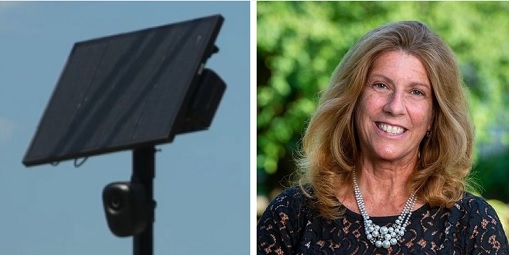
The city deployed Flock Safety automated license plate reader (ALPR) cameras. The cameras record a vehicle’s license plate, make and model, body type (SUV, truck, sedan, etc.), color, state of registration, temporary tags, missing plates, and distinctive features such as roof racks, bumper stickers, and unique decals.
Podcaster Craig Bushon noted: “You don’t need a face to know where a person is — you just need to know their car. And that’s where civil liberties alarms start ringing. The same system that can catch a criminal can also map your daily life. Every trip to church, every political rally, every visit to your doctor — logged and time-stamped.”
Troy residents strongly objected to the cameras during packed city hall and public safety meetings.
The Troy City Council got the message and voted to end the city’s contract with the Flock cameras.
But Mayor Carmella Mantello overturned the council and declared a state of public emergency, allowing for the cameras to remain up.
Troy residents then took matters into their own hands. Newly installed Flock cameras at three locations were cut down.
Mantello, the mayor of the city of 50,000, posted to Facebook: “City License Plate Readers (LPRs) damaged last night. This is a disturbing pattern which started out with graffiti on city property and vehicles and businesses, then panhandling signs, and now has grown to tearing down the LPRs. This is violent and unhinged behavior and is escalating into a very disturbing pattern. We will not tolerate this violence.”
Deidre Shea, who serves as a spokesperson and organizer for the community-advocacy group DeFlock Troy, told NBC 13:
“There’s been a nationwide concern about Flock cameras. Some people feel like they need to take matters into their own hands when their government is not. It’s unfortunate.
“And right now this technology is totally unrestricted and can be used without a warrant. Do you want somebody to be following you around town without a warrant? You want there to be probable cause. You want there to be due process. And there aren’t any rules around that right now.”
Bushon noted in his podcast:
Flock may not capture faces today. But what about tomorrow? And even without face ID, enough data points can build a profile every bit as invasive.
The ratchet effect is clear:
Today: Vehicle fingerprinting with 30-day retention.
Tomorrow: Drones patrolling above neighborhoods.
Next year: AI linking it all together into predictive policing dashboards.
The company will say it’s about eliminating crime. But history tells us something else: capability always seeks application.
If you want to see what happens when surveillance layers lock together, look at China’s surveillance triad.
Golden Shield (1998–2006): The backbone. It unified police databases — household registration files, biometrics, political dossiers, travel logs — and created the infrastructure behind China’s infamous Great Firewall. It centralized information control and policing at a national level.
Skynet (2000s onward): The eyes. Hundreds of millions of cameras with AI-driven facial recognition blanket cities. In 2017, a BBC journalist in Guiyang tested the system: within seven minutes, police intercepted him after cameras flagged his face. Skynet provides real-time identification, tying faces to ID cards across urban China.
Sharp Eyes (2015 onward): The community arm. Its slogan — “The masses have sharp eyes” — pushed surveillance into villages and even living rooms. In some towns, residents could flip on their TVs and watch live feeds of local streets, deputizing ordinary citizens as watchers. Sharp Eyes filled the gaps Skynet left in rural areas.
Together, these systems created a layered dragnet: Golden Shield as the database spine, Skynet as the AI-powered eyes, and Sharp Eyes as the community enforcement arm.
And it doesn’t stop there. In Xinjiang, this architecture enabled predictive policing, movement restrictions, and mass detentions of Uyghurs and other minorities. Databases, biometrics, and AI fused into a chilling apparatus of control.
Here’s the part that should make Americans pause.
China proudly named its national surveillance project Skynet — the very name of the rogue AI in The Terminator. In the films, Skynet became self-aware, turned defense systems against humanity, and unleashed global war.
In Beijing, Skynet is real. It doesn’t launch missiles — yet — but it erases privacy, catalogs behavior, and automates social control.
What happened in Troy is not the first time Flock cameras have been cut down.
In Suffolk, Virginia, Jeffrey Sovern, a 41-year-old U.S. Air Force engineer, faces 25 charges after police accused him of damaging or destroying 13 Flock cameras between April and October 2025. Authorities say he dismantled poles, discarded units onto a highway, and kept solar panels and other components.
Sovern has pleaded not guilty, arguing the systems violate the Fourth Amendment by enabling warrantless tracking of ordinary drivers. Privacy advocates have raised more than $15,000 for his legal defense.
Similar incidents have been reported in Houston, New Mexico, Iowa, and elsewhere, reflecting growing tension over automated license plate readers and the limits of mass surveillance, Military.com reported.
🚨#BREAKING: An INSANE story is unfolding in Troy, New York where a mayor who overrode her own city council’s vote to END their Flock camera contract, by declaring a “public emergency,” is now FUMING after citizens began cutting down the cameras!
The female mayor said that… pic.twitter.com/dpZpOuGDqM
— Matt Van Swol (@mattvanswol) July 27, 2026
Freedom Rocks! Until It Is Gone

Americans in Troy, NY rebel against China-style flock cameras added by Editor Two on
View all posts by Editor Two →