
by WorldTribune Staff, August 21, 2026 Non-AI Real World News
President Donald Trump can continue construction on his White House ballroom as the Supreme Court weighs his emergency appeal to allow the project to proceed, the court ruled in an interim measure issued on Friday.
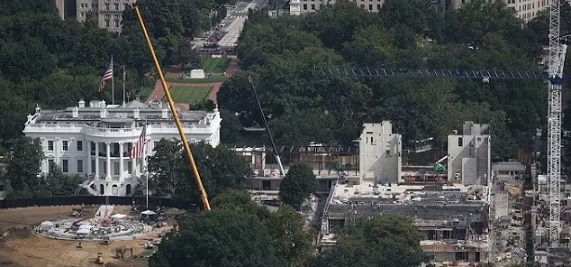
The administrative stay, gives the justices more time to consider whether a lower court’s stop-work order on the ballroom should take effect.
Without the Supreme Court’s action, the lower court’s injunction would have kicked in on Saturday and immediately halted construction of the project that Trump says is needed for national security.
According to the White House, 65% of the work has already been completed on the planned 90,000-square-foot ballroom. Crews are working 20 hours a day, seven days a week on the project, where about $200 million in private donations has been spent or committed, according to court documents filed by the Justice Department.
Two lower courts have ruled that Trump exceeded his authority when he tore down the East Wing of the White House in a matter of days last fall and immediately began construction on the ballroom without the approval of Congress. But he has been allowed to keep building while his administration pursued appeals.
In an emergency appeal to the Supreme Court last week, Trump asked the justices to let work continue on what the president says is an integrated “military complex.”
Friday’s administrative stay came in a one-sentence order issued by Chief Justice John Roberts.
The stay issued by Roberts has no expiration and will remain in place until the Supreme Court takes further action.
Solicitor General John Sauer told the justices that it is too late to stop work now because the project is 65% done, “moving quickly toward completion” and “past the point” where major changes can be made.
Stopping work at this point “will be a disaster,” Sauer wrote, quoting a sworn statement from the director for White House management and administration.
A district court judge ordered a stop to aboveground construction of the planned ballroom in April in a ruling that was suspended before being upheld by an appeals court panel. The order from U.S. District Judge Richard Leon in Washington allowed belowground work on bunkers and military installations to continue.
Two appeals-court judges appointed by Democratic presidents found the project was for Congress to decide and “not a matter for Executive self-help.” A third judge, appointed by Trump, found that the preservationist group challenging the project had no legal standing to sue.
250 Years of Freedom Is At Risk

Supreme Court: Trump can keep building White House ballroom amid emergency appeal added by Editor Two on
View all posts by Editor Two →