
by WorldTribune Staff, August 21, 2026 Non-AI Real World News
Security analysts have raised alarms regarding a Chinese state-owned entity’s integration into the South Korean energy sector, arguing that allowing the U.S.-blacklisted entity direct access to South Korea’s domestic power grid introduces major national security vulnerabilities for both South Korea and the U.S. military forces stationed on the peninsula.
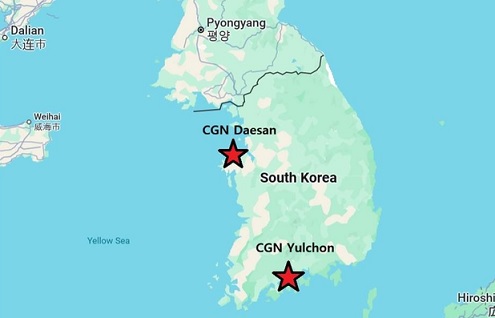 China General Nuclear Power Corporation (CGN) operates five power generation facilities in South Korea.
The U.S. Department of Commerce added CGN to its Entity List during the first Trump Administration in 2019. The trade restrictions effectively ban American companies from exporting technology to the firm. The U.S. government established the blacklist after accusing CGN of diverting advanced U.S. nuclear technology for Chinese military use.
East Asia Research Center reported on July 24 that CGN announced it began commercial operation of a 557 megawatt LNG combined cycle power plant in the Daesan Industrial Complex in Seosan City, South Chungcheong Province.
“Petrochemical companies are in and near the Daesan Industrial Complex, and the power plant is about 45 miles west of Camp Humphreys U.S. Army base,” the report said.
CGN, through subsidiary CGN Yulchon Electric Power, also operates the Yulchon Combined Cycle Power Plant located in the Yulchon General Industrial Complex #1 in Gwangyang City, South Jeolla Province. The power plant is in the same industrial complex as Hyundai Steel Suncheon factory and Hyundai Steel pier.
According to the FBI, CGN has been stealing U.S. nuclear secrets for almost two decades, the report noted.
“CGN used joint ventures, partnerships, and other legitimate international commerce practices to infiltrate the U.S. nuclear technology network and steal advanced nuclear reactor designs that could be dual use,” the report said.
CGN is also on the U.S. Department of War’s Entities Identified as Chinese Military Companies.
“CGN, acting as an intelligence collection platform, engaged in decades of sophisticated economic espionage in the U.S. to steal dual use technology using regular commercial practices,” the report said.
“CGN could engage in economic espionage in a similar way in the Republic of Korea (ROK) as well. Furthermore, with the access to the power grid and the energy technology network (including nuclear energy network) in the ROK, it could sabotage the power production and distribution. Thus, CGN operating in Korea poses a grave threat to the national security of the ROK as well as the U.S.”
Freedom Rocks! Until It Is Gone

Access to South Korea’s power grid by blacklisted Chinese company impacts U.S. forces added by Editor Two on
View all posts by Editor Two →