
 By John J. Metzler, September 3, 2026
A few months ago while in the Hague, I remembered Gen. Ratko Mladic, the gruff Serbian general who I thought might still be alive and serving his life sentence in a nearby UN prison for what is legally called “crimes against humanity.
The old UN “International Criminal Tribunal for the former Yugoslavia” (ICTY) handed down a tough but deserving verdict and threw away the key for Mladic, the former commander in chief of the Bosnian Serb Army.
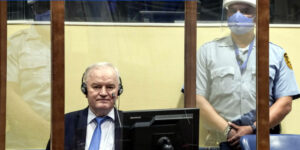
It turns out that Gen. Mladic, the Serbian “Butcher of Bosnia” during the Yugoslav civil wars, died in prison in the Hague at 84 on Aug. 27.
Convicted of genocide for the gruesome Srebrenica massacre and a string of other atrocities in Bosnia and Croatia, Gen. Mladic emerged as a bizarre Serbian folk-hero whose brash bravado became a hallmark of the disintegration of old Yugoslavia.
Not surprisingly Mladic’s upcoming funeral “will receive all the military and state honors” according to Belgrade’s media.
Mladic often boasted he was avenging centuries of Ottoman Turkish rule in the Balkans through his hardline Serbian nationalism.
After a nearly year-long trial with hundreds of impassioned witnesses, Mladic was sentenced to life in prison in 2017 by the Hague tribunal. He joined many other Serbian and even Croatian War criminals in custody, but this is a chapter now nearly a generation ago.
Today we have Ukraine, an eerie similar saga unfolding in contemporary Europe.
The Yugoslav civil war in the 1990’s flared in the aftermath of the political breakup of the old Socialist Federal Republic of Yugoslavia, a multi-ethnic union of force among the Croatians, Bosnians, Slovenes, Montenegrins led by the iron hand of the Serbs in Belgrade.
When the union first unraveled peacefully in northern Slovenia, people assumed the rest would crumble peacefully; After all Marshall Tito the tough wartime leader was dead, and this was presumably another era.
But being the Balkans, a bloody civil war followed, primarily in Bosnia and Croatia. Nearly 100,000 people were killed in Bosnia along with creating with two million refugees.
Chaos and a conflict the likes of which were not seen in Europe since WWII followed.
The international community tried to stop the carnage; the UN condemned the violence but the fighting expanded. Later UN peacekeeping forces were inserted, the UNPROFOR units largely ineffective to stop the fighting. Then the formerly multicultural Bosnian capital Sarajevo, which hosted the Winter Olympics in 1984, was under siege by Serbian artillery.
More than 11,000 civilians died. Later in July 1995, the Srebrenica massacres saw over 8,000 Bosnian men herded into killing fields where they were summarily executed, recalling the Nazis in WWII.
The world was shocked but did little. Russia backed the Serbs, its historic ally. Western Europeans, primarily Germany and Austria supported the Croatians.
But the tragic flow of refugees from the Yugoslav wars soon washed the frontiers of Europe, especially Austria and Germany where now a generation later these people are largely successful communities.
Though indicted by the ICTY in 1995, Mladic was able to hide out in Serbia for sixteen years aided by a clandestine rat-line of ex-military and hyper-nationalist Serbs.
After his arrest in 2011, Mladic finally faced the litany of his crimes especially against Croatian Catholics and Bosnian Muslims.
Radovan Karadzic, the political leader of the Bosnian Serbs, after a decade in hiding, was captured too and was equally convicted of crimes against humanity by the ICTY. He is serving a forty-year sentence in a British prison.
The Republika Srpska (RS), a rump region of a complicated ethnic patchwork of borders defined by religion inside Bosnia-Herzegovina, exists to this day. In turn Serbia became a pariah state, especially when after the Balkan wars it tried to crush the Kosovar Albanian minority.
Mladic ran the infamous Serbian paramilitary militias, not the formal Yugoslav regular Army.
The militias in Croatia and Bosnia-Herzgovina would fight local pro-independence insurgents but burn villages and randomly kill innocent civilians in what became known as “ethnic cleansing.”
The Serb militias carved out enclaves such as the Krajina in Croatia or the RS just outside Sarajevo where folkloric regimes of Serb nationalist rule would coexist alongside struggling newly independent countries.
The American backed 1995 Dayton Accords created Republika Srpska as part of Bosnia-Hertzgovina’s two constituent entities. The RS has approximately one million mostly Serb population.
The Balkan wars of the 1990’s are largely forgotten. Contemporary Croatia and Slovenia are fairly prosperous lands with a vibrant tourist industry and significantly are members of NATO and the European Union.
Bosnia still suffers in a limbo from the past, and Serbia endures its self-inflicted wounds baring becoming what many would call a “normal state.”
John J. Metzler is a United Nations correspondent covering diplomatic and defense issues. He is the author of Divided Dynamism the Diplomacy of Separated Nations: Germany, Korea, China (2014). [See pre-2011 Archives]

‘Butcher of Bosnia’ dies, but his legacy lives on in Serbia added by Editor One on
View all posts by Editor One →