
by WorldTribune Staff, September 25, 2026 Non-AI Real World News
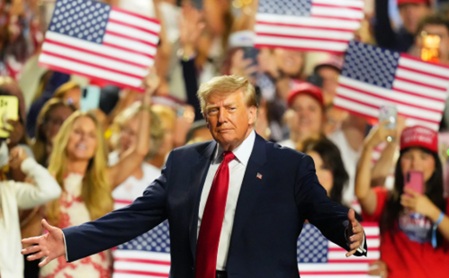
The Trump Administration is engaged in a multi-pronged federal campaign focused on “election integrity” and voter roll security ahead of the November midterms. This despite a setback at the U.S. Supreme Court and the failure of the U.S. Senate to pass the Save America Act
Administration officials describe the effort as a “comprehensive,” common-sense national strategy to eliminate ineligible voters and verify citizenship.
 The Department of Homeland Security (DHS) has obtained voter rolls from at least 47 states for review under the Trump Administration’s “Unlawful Voter Initiative,” Reuters reported Thursday.
As many as 30,000 non-citizens had been added to voter rolls since 2000 as a result of software glitches and errors stemming from the automatic registration of illegal aliens who apply for state driver’s licenses, the report said.
“The real story here is after decades of the media denying that non-citizens register and vote in our elections, they are finally being forced to admit after a flurry of recent arrests nationwide that it does happen,” said White House spokeswoman Lauren Bis.
On July 21, New Jersey Democrat Gov. Mikie Sherrill admitted that 6,600 non-citizens were found on Garden State voter rolls and that roughly 400 had illegally cast ballots in elections between June 2023 and June 2024.
Project Civica, a non-partisan government accountability organization, has indicated that more than 10,000 non-citizens could be registered to vote in New York.
California may have as many as 35,152 non-citizens on its voter rolls, according to a preliminary DHS review first reported by Fox News.
Related: Columnist to GOP: Get ready for the Spencer Pratt experience thanks to the Supreme Court, September 23, 2026
Homeland Security Secretary Markwayne Mullin cited the review in a July letter noting that 190,832 non-citizens may currently be registered to vote in California, New Jersey, Nevada and Pennsylvania.
In total, the DHS review assessed that 278,000 non-citizens were registered to vote nationwide, according to the White House. DHS has never publicized the full data from its review.
“Election security is national security,” Homeland Security Secretary Markwayne Mullin said in a statement. “This plan, which will be implemented in full, is crucial to the security, freeness, and fairness of choosing the leaders of our country. Making America safe again isn’t just done at the border, in our streets, and on the coast — it’s also done in protecting the integrity of American elections.”
President Donald Trump’s election integrity strategy includes several major policy directives and legal actions:
Voter roll purges and data demands: The administration has targeted state voter rolls, claiming it identified hundreds of thousands of potential non-citizens and deceased individuals registered across key states. The Department of Justice has pressured states to turn over voter records.
The SAVE database: The administration is fighting to utilize the federal Systematic Alien Verification for Entitlements (SAVE) database to run large-scale citizenship checks against state voter registries. Lower courts previously blocked this, but the Supreme Court on Friday paved the way for Trump’s team to implement it. The Department of Homeland Security (DHS) plans to compile and release state-specific lists of eligible U.S. citizens.
Presence at the polls: Administration officials have suggested the possibility of deploying armed federal law enforcement or immigration agents near voting sites.
The Federalist reported on Thursday that it obtained the administration’s 2026 Election Infrastructure Security Plan which includes numerous tools and services that election officials can use to protect election infrastructure from physical and cyber threats in the midterms. The extensive report was produced by the Cybersecurity and Infrastructure Security Agency (CISA), which falls under DHS.
The 13-page document begins by providing a comprehensive overview of existing election infrastructure (voting and processing facilities, voting hardware, etc.) and the core technological components (voter registration systems, tabulation systems, etc.) that define a typical election process. It also includes an analysis of potential cyber and physical threats to this infrastructure that officials may encounter during the 2026 contest, such as attempted cyber hacks of state voter registration databases and bomb threats directed at election offices.
The CISA plan advises election officials to consider using paper ballots “that can be easily reviewed to ensure transparency, auditability, and resilience against software failures or manipulation,” and to “[c]onduct post-election manual audits of paper ballots to verify that voting systems function properly and to identify errors before certifying the final results.”
The Trump Administration’s election security plan “is a notable pivot for CISA, which previously operated as the ‘nerve center’ of the censorship-industrial complex,” The Federalist’s Shawn Fleetwood noted.
“While created in 2018 to safeguard critical U.S. infrastructure and guard against cybersecurity threats, a 2023 House GOP report found that CISA had ‘metastasized’ into a weapon used in the federal government’s ‘domestic surveillance and censorship operations on social media.’ A separate House report released later that year showed that CISA colluded with Stanford University to pressure Big Tech companies into censoring prominent conservative voices leading up to the 2020 election.”
The total generic ballot for recent midterms:
2022 – GOP 54.2M, DEM 51.2M
2018 – DEM 60.6M, GOP 50.9M
2014 – GOP 40.1M, DEM 35.6M
2010 – GOP 44.8M, DEM 39.0M
2006 – DEM 42.3M, GOP 35.9MTurnout models tend to estimate that we will see higher raw turnout than 2018, with turnout…
— Red Eagle Politics (@RedEaglePatriot) September 25, 2026
250 Years of Freedom Is At Risk

Fight, fight, fight: Team Trump mounts all-out push for midterms election security added by Editor Two on
View all posts by Editor Two →