
by WorldTribune Staff, October 6, 2026 Non-AI Real World News
Chinese components in the equipment used by America’s largest voting technology companies have sparked renewed concerns about Beijing’s pursuit of backdoors into U.S. critical infrastructure.
The Department of Homeland Security (DHS) announced in August it will require random audits of paper ballots in the November midterms, citing the possibility that the Chinese components could be exploited by hackers or other malicious actors.
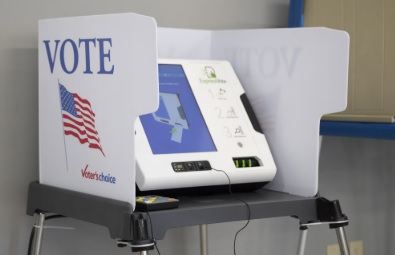 In a letter to the White House Transparency Task Force, Homeland Security Secretary Markwayne Mullin highlighted longstanding concerns first raised in a bipartisan manner before the 2020 election, but which officials appear to have taken little action on since.
“Voting machines with components manufactured by foreign adversaries introduce significant security risks,” Mullin wrote. “These vulnerabilities mean that malicious actors could potentially compromise election infrastructure at any stage of the supply chain, even before the machines are assembled or deployed.”
He cited A National Intelligence Council Memorandum from October 2024 which stated:
We assess that some U.S. adversaries — at a minimum China, Iran, and Russia…have the technical capability to access some U.S. election-related networks and systems.
Mullin continued: “If a component is tampered with during manufacturing, it could serve as a point-of-entry for hackers, allowing for the possibility of synchronized attacks across multiple machines and jurisdictions.”
Related: Trump won’t rule out declaring state of emergency for midterms, October 2, 2026
Two Biden administration Intelligence Community memos in 2024 identified China as “the most active and persistent cyber threat” and assessed that China, along with Iran and Russia, has “the technical capability to access some U.S. election-related networks and systems.”
Mullin noted major U.S. voting machine companies have acknowledged that some of their components cannot be sourced from any American manufacturers, requiring them to rely on foreign suppliers. Three of those vendors which make up the vast majority of election systems in the U.S., “more than 80%,” are ES&S, Hart InterCivic, and Dominion (now Liberty Vote).
Each of these vendors has previously said that their machines have parts made in China.
Mullin’s comments created a stir with election fact-checkers who admitted concerns over voting machine vulnerabilities have been raised for years, but continue to insist there is no proof any foreign actor has actually attempted to hack into the machines.
PolitiFact cited J. Alex Halderman, University of Michigan computer science and engineering professor who studies electronic voting machines as agreeing that voting machines have weaknesses that can allow foreign adversaries to tamper with voting machine hardware and weaken the machines’ security.
However, “It’s important to note that there’s no evidence that voting machine vulnerabilities have ever been used to attack a real U.S. election, and of course the existence of vulnerabilities does not mean those vulnerabilities will imminently be exploited,” he said
Halderman was part of an academic group in 2006 that analyzed the security of certain voting machines that let voters cast and store their votes electronically, sometimes without a paper record of their vote.
“What we found was disturbing,” Halderman told the Senate intelligence committee in 2017. “We could reprogram the machine to invisibly cause any candidate to win.”
According to documents previously declassified by President Donald Trump and made public by the White House Transparency Task Force in July, the U.S. Intelligence Community also harbored concerns after vulnerabilities were exposed by a Venezuelan regime plot to manipulate its own election machines.
The Trump Administration has declassified several tranches of documents outlining concerns about election vulnerabilities, seeking to bolster its efforts secure American elections ahead of the midterms. These include:
• Evidence that China has obtained 220 million American voter registration files, some of which include non-public data, through buying, stealing or hacking. The administration’s intelligence chiefs later said that this represents “election interference.”
• Assessments from spy agencies beginning in 2020 that at least five foreign powers, China, Russia, Iran, North Korea and Venezuela, possess the ability to hack voting machines.
• Evidence gathered by the Homeland Security that hundreds-of-thousands of likely illegal foreign voters were on states’ voter rolls and estimated the total across the whole country to be higher.
• Documents that show the FBI investigated a breach of voter registration data in Arizona’s largest county in the days before the 2020 election. In that incident, a self-described hacker foiled security and obtained 633,000 voter registration files. The Biden Justice Department and local prosecutors declined to bring charges.
Andrew Appel, Princeton University professor emeritus of computer science who studies the technology policy of voting machines, said most voting machines today are more secure than the ones designed in 2000.
The vulnerabilities that still exist are why most states still use paper ballots that are marked by hand and recountable by hand, Appel said. Paper ballots provide a way to verify and audit votes.
Earlier this year, the Trump Administration moved to ban the import of all internet routers manufactured in foreign countries because of the unacceptable security risks posed by Chinese hacking capabilities.
Former Colorado clerk Tina Peters just met with Trump at the White House to discuss voting machines and election security — according to former Justice Department official Ed Martin.
Martin posted to social media: “We are in a crisis stage of the midterm elections. DHS secretary Mullin has said that foreign interference is possible, and the machines are not secure. That is his finding. We must avert the crisis. All hands on deck.”
BREAKING: TRUMP TAKES ACTION ON ELECTION INTEGRITY AHEAD OF MIDTERMS
@EagleEdMartin reports that Tina Peters met with President Trump in the Oval Office just hours earlier to discuss voting machines, election security, and the SAVE America Act.
“The president’s taking it seriously.”
“It is not a local issue when it’s national security, and it’s clearly national security.”
@ericbolling
— Real America’s Voice (RAV) (@RealAmVoice) October 5, 2026
250 Years of Freedom Is At Risk

Made-in-China election machine hardware? Homeland Security letter raises alarms added by Editor Two on
View all posts by Editor Two →