
Analysis by WorldTribune Staff, November 22, 2026 — Real World News
The Nov. 19 first-ever trilateral meeting between the world’s three largest nuclear powers ended with a consensus by U.S. President Trump, Chinese Communist Party leader Xi Jinping, and Russian leader Vladimir Putin on a four-point “Declaration toward Peace.”
The declaration, which came on the sidelines of the APEC summit in Shenzhen, China, has been dismissed by multiple analysts and media commentators as optics over substance.
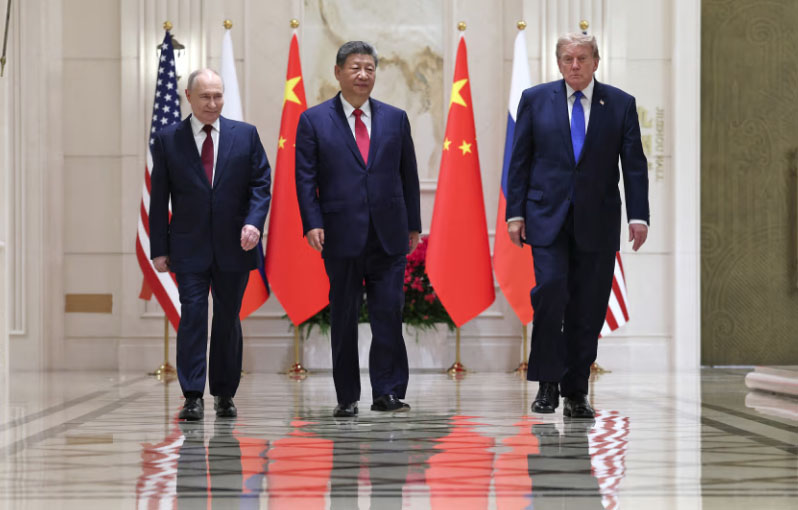
But there could be no disputing that history was made by the leaders of the three most powerful nations in the world sitting together without any one of them claiming to lead the summit.
The declaration was largely symbolic and avoided direct mention of the ongoing wars in Ukraine and Iran.
At the same time, it would be fair to term the event a “peace summit” as leaders of the three nations with about 90 percent of the world’s nuclear weapons (according to the Federation of American Scientists), walked away from the event feeling acknowledged and happy with the outcome.
The “Declaration toward Peace” affirmed the following:
• Nuclear risk reduction: The leaders reaffirmed that “a nuclear war cannot be won and must never be fought” and pledged to hold dialogue on preventing proliferation.
• Energy supply: The three countries agreed to boost the production and supply of refined petroleum products to ensure stable global energy flows.
• United Nations reform: As permanent UN Security Council members, they committed to reforming the body so it can respond more effectively to global challenges.
• International courts: The statement emphasized state consent and the immunity of state officials, asserting that the International Criminal Court (ICC) must not “abuse its jurisdiction.”
Significantly, Trump came to Shenzen after heading the arguably much more consequential Quad Leaders’ Summit on Nov. 17, in Manila, Philippines, alongside Japanese Prime Minister Sanae Takaichi, Indian Prime Minister Narendra Modi and Australian Prime Minister Anthony Albanese. Initiated in 2007 by the late Japanese Prime Minister Shinzo Abe, it marked the group’s first leader-level gathering since 2024.
At his White House briefing on Friday, Trump called the summit “fantastic” and highlighted several new initiatives which no doubt appalled the divide-and-conquer strategists in Beijing:
• Quad Business Leaders’ Forum: A new forum focused on economic security and supply-chain resilience, with its inaugural meeting set to be hosted in Mumbai in 2027.
• Critical minerals & maritime security: Agreements were reached to loosen China’s grip on critical mineral supply chains and launch new joint Indo-Pacific maritime surveillance operations and military exercises in 2027.
• Quad SI accelerator. A partnership aligning the four nations to develop “Super Intelligence,” though Trump noted the U.S. is leading the effort and intends to keep primary development within the United States.
During his post-summit White House press briefing on Friday, Trump addressed a central issue at the Shenzen meeting, reiterating his administration’s rebranding of Artificial Intelligence (AI) as “Super Intelligence” (SI) — arguing that the technology is “super,” not “artificial.”
Discussing global tech competition, Trump emphasized, “Whoever wins SI wins,” framing leadership in the sector as the defining geopolitical race of the era.
Key points from his remarks include:
• Domestic Data Centers: Trump vowed to prevent U.S. tech companies from building data centers overseas, insisting that critical SI infrastructure must be constructed inside the United States.
• U.S.–China competition: While claiming the U.S. holds a commanding lead over second-place China, Trump noted that he and Xi discussed the technology and agreed to explore “joint guardrails” to manage the risks of systems becoming “too super.”
• Philippines deal: Buy 100 percent U.S. farm products (not 95). “Will Brazil help out if they have a little skirmish w China?”
• “SI bigger than industrial revolution”: No data centers built outside U.S. as China will take all of them.
• “Cartels are running Mexico.” The U.S. and Mexico’s President Claudia Sheinbaum cannot allow that
• Putin and Zelenskyy: “Tremendous hatred” between the two. Trump cited Putin’s comment that the war would never have happened under a President Trump.
• Bilateral talk with Xi. Fentanyl shipping is down 97%.
• Yalta? “It was an amazing event. …. Amazing energy. Xi did a great job.” Shenzhen is new clean city. “Look at our blue cities.”
Though Trump, Xi, and Putin “reaffirmed that a nuclear war cannot be won and must never be fought,” the leaders didn’t announce concrete plans for arms control or stockpile reduction.
The Stockholm International Peace Research Institute reported that China has nearly 620 warheads, while the United States has 3,700 and Russia has 4,400. China’s arsenal is growing faster than any other country’s, according to the institute’s latest assessment.
The Shenzen summit also brought home to visiting journalists that the freedoms taken for granted in the West do not exist in communist China.
The Epoch Times noted: “One detail that made headlines on Nov. 19 was that reporters traveling back to the United States with Trump were told by U.S. staff to surrender their phones just before boarding Air Force One. While journalists are not typically required to hand over their devices, the White House appeared to take precautions to reduce the risk of surveillance, hacking, or data theft by Beijing.
“Similar security measures were implemented during Trump’s visit to China in May. Before departing on that trip, White House staff collected all badges, pins, and burner phones and discarded them in a bin at the bottom of the stairs before reporters boarded the plane.”
Chinese officials barred Bloomberg TV reporter Annmarie Hordern from covering the trilateral summit in Shenzhen after she shouted a question at Trump during an earlier event.
The incident happened on Nov. 19 during the bilateral meeting between Trump and Xi, where Hordern asked the U.S. president whether former Nvidia CEO Jensen Huang had been disloyal to the United States. Neither leader responded to the question.
Later, Chinese officials blocked Hordern from the U.S.–China–Russia summit, calling her behavior rude. They also rejected White House efforts to grant her access.
“During the China visit, White House reporters frequently witnessed censorship by the CCP,” The Epoch Times noted.
“There’s no freedom of the press here,” said Fox News reporter Bill Melugin while reporting live from Shenzhen.
He said that in the past few days, whenever another network made critical comments about China, the CCP, or Xi, the broadcast feed was cut and replaced with color bars until the segment was over.
The CCP censored CNN’s live broadcast feed inside China on Nov. 17 when the network reported on alleged Chinese espionage targeting Huang.
Trump held a bilateral meeting with Putin on Nov. 19 before the trilateral meeting on the sidelines of the Asia-Pacific Economic Cooperation summit in Shenzhen.
“We’ve had a great relationship for many years,” the U.S. president told reporters at the beginning of the meeting. “We knew each other for a long time, and I think a lot of wonderful things can come out of this, or at least start.”
The two leaders discussed the war in Ukraine and bilateral relations during their nearly 40-minute meeting, Kremlin foreign policy adviser Yuri Ushakov told reporters, according to Russian news agency TASS.
Putin left the meeting in an “excellent” mood, Ushakov said.
Speaking after the Shenzhen summit, Putin said Kyiv and Europe are not ready to make compromises to end the war in Ukraine.
Freedom Rocks! Until It Is Gone

Trump cites ‘peace declaration’ in Shenzen on heels of ‘Quad’ summit; ‘Whoever wins SI wins’ added by Editor Two on
View all posts by Editor Two →