
Special to WorldTribune, May 8, 2026 Real World News
By Geostrategy-Direct, May 5, 2026
By Richard Fisher
While the National Aeronautics and Space Administration (NASA) is trying to extend the retirement schedule of the International Space Station (ISS) from 2030 to September 2032, China is confirming plans to double the size of its Tiangong small space station.
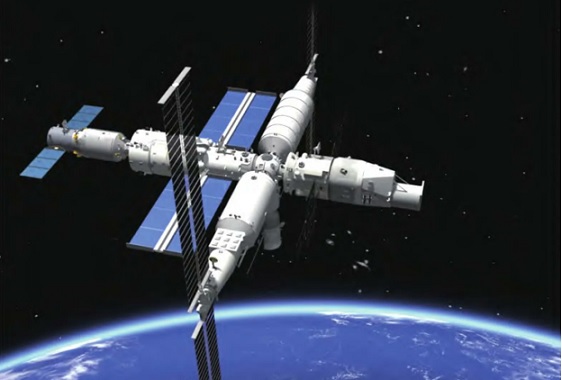
Currently, the 450 metric ton ISS is about 5 times the weight of the 90-ton Chinese Tiangong, which offers about 340 cubic meters of internal working space, or about one third of the over 1,000 cubic meters offered by the ISS.
Tiangong usually hosts a 3-astronaut crew, with a maximum of 6 during crew rotations that can last a week, while the ISS hosts about 7 astronauts with temporary increases up to 17 during crew rotations.
Then on April 30, Ohio, USA-based reporter Ling Xin of the undeclared Chinese state media South China Morning Post (SCMP) stated:
“China has confirmed plans to expand its space station, potentially more than doubling in size to meet growing scientific demand and expand international cooperation.”
Of the expansion she added that a, “…new module will have multiple docking ports, including for a pair of future laboratory units, paving the way for a six-module structure with a total mass of about 180 tonnes.”
Ling Xin did not cite an official source for this confirmation, but for a number of years there has been speculation and “grey data” from Chinese sources regarding potential Tiangong expansion plans.
For example in October 2018, an engineer from the China Academy of Space Technology (CAST) provided a briefing on an expanded Chinese space station, so this was not a surprise.
The expansion will start with a new module about the size of the core “Tianhe” module, that apparently will include a large airlock for deploying astronaut extra-vehicular activity (EVA) missions, or any number of payloads.
This second large module will then receive two additional modules for multiple missions, and it is likely that solar panels will be increased to support greater energy demands.
This will be a busy year for Tiangong; the 12th crew rotation could occur this month, and this year could see special guest crew from Hong Kong, Macau and Pakistan.
Furthermore, later this year China plans to send an uncrewed test version to Tiangong of its new Mengzhou manned spaceship that will take Chinese astronauts to the Moon by 2029 or 2030.
Full Report . . . . Current Edition . . . . Subscription Information

China to double size of its space station as ISS prepares to go commercial added by Editor Two on
View all posts by Editor Two →