
Special to WorldTribune.com
 By John J. Metzler, May 11, 2026
THE HAGUE — Among the attributes of the Dutch people are hard work, punctuality and friendly free spirits. But when the new Netherlands coalition government was formed earlier in the year, one of its first steps was a massive tax increase on an already overburdened population.
The increase of the Value Added Tax (VAT) from an already robust 9 percent to 21 percent, literally overnight, has jolted business ledgers and key sectors, among them tourism and the famous flower industry.
Naturally as in most European countries, never mind American states, the government is addicted to higher spending, expanding “services” and keeping a bloated bureaucracy afloat.
In the case of the Netherlands creaking new minority three-party coalition government, lacking a Parliamentary majority, it has proposed a “Let’s Get to Work; Building a better Netherlands” program with some novel fiscal policies for this largely prosperous country of 18 million people.
The 21 percent VAT hits the hospitality industry, namely hotels which are already feeling the pinch as summer approaches and tourists from neighboring countries are shying away from bookings. Equally according to industry sources, domestic Dutch tourism has seen a dip in reservations too.
Certain hotels are feeling the fiscal pain, but many managers concede they are “absorbing some of the new tax costs” as not to dampen foreign bookings.
Some hotel groups, especially in the tourist nexus of Amsterdam, have noticed a falloff in bookings. But even in the Hague, the staid seat of government, higher taxes have equally had an impact on tourism as restaurant and drink prices have risen.
The VAT comprises a value added tax on goods and services which is a consumption tax that is levied on the value added at each stage of a product’s production and distribution.
All European Union countries have high VAT’s; with Belgium at 21 percent, Germany at 19 percent and Sweden at 25 percent. Only non-EU Switzerland has a lower VAT at 8 percent.
Fortunately, the government doesn’t want to increase gasoline taxes, the current price it just over $10.50 per gallon! (You read correctly). Euro News reports that the Netherlands has the highest petrol and diesel prices in Europe.
Given the size of the Dutch trucking industry, diesel prices as in the USA, will pass on transport costs to consumers. But despite higher fuel costs for personal vehicle travel and transportation, train fares will equally increase by just over 6 percent.
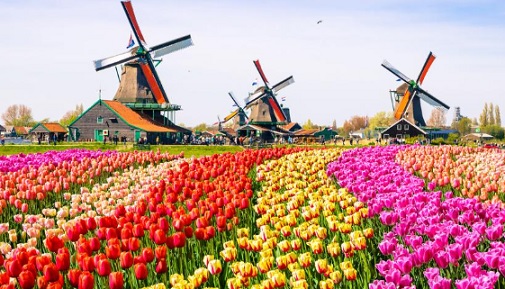
Importantly, the Netherland’s major horticulture industry, the marketing of Holland’s flowers, is also feeling the VAT tax pinch. Royal Flora Holland, the huge growers cooperative and distribution center, deemed the new tax initiative as “a very bad plan by the new government.”
Wageningen University & Research points to a fall in sales of almost $459 million and the loss of nearly 2,400 full-times jobs in the horticulture sector, adds the Holland Times newspaper.
The new government, led by Prime Minister Robert Jetten of the progressive D66 center-left party and two smaller libertarian parties in coalition including the VVD People’s Party for Freedom and Democracy, face pushback and political “horse-trading” from many of the fifteen parties in Parliament.
Meanwhile In London
Just across the North Sea from the Netherlands, I can’t help but comment on the seismic political events in the United Kingdom. Local and regional Council elections throughout the UK delivered a greater than expected shock to both the sitting Labour government and the opposition Conservatives who suffered stunning political losses to the populist Reform Party and to a degree by the hard-Left Greens.
These elections were not based on traditional ideology but on how government performs or doesn’t on the local council level.
For example, ruling Labour lost 1,496 seats nationally while holding just over 1,000. The Conservative lost 563 seats but held 801. But upstart Reform of Nigel Farage, won a stunning 1,453 seats while the Greens gained 441. Not surprisingly, Reform showed best in areas which supported Brexit a decade ago. And Labour lost badly to Reform in regions which were traditionally trade union and post-industrial but fed up with Labour’s political promises. But as the Spectator conceded, “Brexit Britain” voters have also deserted the Conservatives to Reform.
BBC pundits pointed to a “political reset” as Prime Minister Kier Stammer’s Labour Party was jolted by results which pointed to a “new political universe,” rather than the more traditional two-party system.
Starmer’s standing has been rocked and he may not hold on.
Rebellion within Labour’s ranks threatens to topple the Prime Minister who came to power just under two years ago in a convincing landslide. But the tides have changed.
John J. Metzler is a United Nations correspondent covering diplomatic and defense issues. He is the author of Divided Dynamism the Diplomacy of Separated Nations: Germany, Korea, China (2014). [See pre-2011 Archives]

Euro turbulence: ‘New political universe in UK; Tax surge punishes hard work in the Netherlands added by Editor One on
View all posts by Editor One →