
Special to WorldTribune, March 18, 2026 Real World News
By Geostrategy-Direct, March 17, 2026
Though its capacity to carry out attacks has been greatly diminished by the United States and Israel, Iran still is able to cause chaos by finally following through on its longstanding threat to close the Strait of Hormuz.
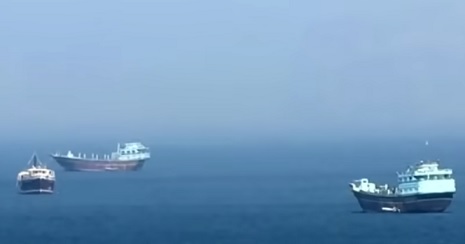
Several vessels are avoiding the critical artery for the global energy market due to the Iranian regime’s threats to target ships.
Satellite images from the Persian Gulf show numerous ships waiting outside the strait to avoid potential attacks.
About 20% of the world’s oil supply passes through the Strait of Hormuz.
Iran is “gambling” on the aspect of “small chances and quality strikes to keep up the deterrence. Countries don’t want small risks, and shipping firms don’t either. They don’t want any risk to crews or civilians,” Seth J. Frantzman noted in a March 16 analysis for The Jerusalem Post.
Iran is well aware that 5,000 U.S. Marines are on the way and also knows that Israel is saying it wants to continue strikes for another several weeks.
“At the same time, Iran has seen that some countries are rejecting the U.S. pressure to help secure the straits with naval ships,” Frantzman noted.
Iran also knows that if it continues to threaten vessels in the Strait of Hormuz, other countries will invest in alternative infrastructure. Countries such as Saudi Arabia, Iraq, and others are reportedly looking at alternative pipelines to use. Iraq, for instance, is seeking to use two pipelines to send oil via Turkey.
“At the moment, Iran likely believes that even a small threat can keep the Strait closed,” Frantzman wrote. “That means it doesn’t have to destroy every ship. All it has to do is threaten or leave a few mines at sea. In addition, the same issue will affect major naval ships. Iran’s drones can be dangerous in small, confined waters. Iran is doing the same thing with its threats regarding the region. It has reduced its rocket and drone attacks dramatically.”
Iran has threatened to close the Strait of Hormuz many times over the past four decades.
Full Report . . . . Current Edition . . . . Subscription Information

Iran’s Strait of Hormuz gamble: Maximum deterrence from decimated arsenal added by Editor Two on
View all posts by Editor Two →