
by WorldTribune Staff, February 6, 2026 Real World News
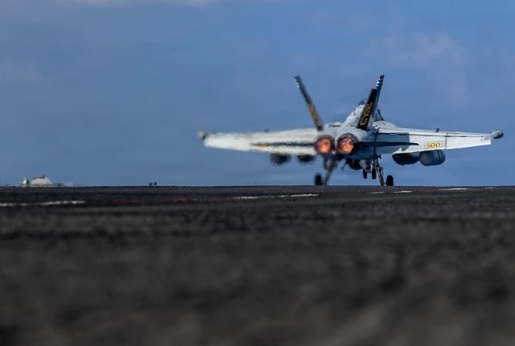
“The USS Abraham Lincoln aircraft carrier battle group arrived near the Persian Gulf in late January, along with F-35 jets and missile defenses that continue to be deployed as part of President Donald Trump’s “armada” bearing down on Iran,” Geostrategy-Direct.com reported this week.
That armada give the United States multiple options, the report outlined. Nevertheless the president, predictably, has kept everyone from the New York Times to the Chinese Communist Party guessing what happens next. In two words: Strategic Unpredictability.
But Trump’s actions over the past year reinforce the conclusion that his words have meanings.
Treasury Secretary Scott Bessent on Thursday said that Ayatollah Ali Khamenei and the ruling clerics in Iran have begun “wiring money out of the country” as President Donald Trump’s pressure campaign accelerates the regime’s economic collapse.
During testimony before the Senate Committee on Banking, Housing, and Urban Affairs, Bessent said that Treasury is seeing unmistakable signs that Iran’s leadership believes the regime is approaching a breaking point.
“We have seen the Iranian leadership wiring money out of the country like crazy,” Bessent said. “The rats are leaving the ship. That is a good sign that they know the end may be near.”
Team Trump’s strategy has hollowed out Iran’s economy, triggered a banking crisis, and sent the country’s currency into free fall, Bessent said.
“At the Treasury, what we have done is created a dollar shortage in the country,” Bessent said, pointing back to a strategy he outlined last March at the Economic Club of New York.
That strategy, he said, reached what he described as a “swift and grand culmination” in December, when one of Iran’s largest banks collapsed, setting off a run on the financial system.
“The central bank had to print money,” Bessent said. “The Iranian currency went into freefall. Inflation exploded. And hence we’ve seen the Iranian people out on the street.”
Nuclear talks between the U.S. and Iran in Oman resumed on Friday and included an in-person meeting between Trump’s top aides Steve Witkoff and Jared Kushner and Iranian Foreign Minister Abbas Aragchi, Israel’s Channel 12 reported.
The rest of the talks were held indirectly, with Oman mediating.
Channel 12 said the U.S. negotiators told their Iranian counterparts that they expect Teheran to come to the next meeting with a tangible and significant concession related to the nuclear file.
The report also indicated that the U.S. will likely take additional steps to boost its military presence in the region on Saturday, improving Washington’s posture ahead of a potential strike if the talks fail.
Trump has sent what he called an “armada” of U.S. ships to the Gulf region.
What does Trump ultimately want from Iran?
“He has said two things, both of them intriguing, but neither one really analyzed by media commentators. First, he has said he wants an end to Iran’s nuclear program. Second, that he wants the regime to stop killing its own people,” Kenneth R. Timmerman noted in a Feb. 5 analysis for American Thinker.
“Remember how quickly both the president and Secretary of War Pete Hegseth were to brush off questions relating to the HEU (highly enriched uranium) stockpile? And then how quickly the subject just seemed to vanish from the airwaves and the press briefings? The 450 kg of 60% HEU Iran was known to possess before the June attacks is enough to produce at least ten nuclear weapons, according to the International Atomic Energy Agency’s own assessment. That is not just a one-off bomb, but a nuclear weapons arsenal,” Timmerman wrote.
“My Iranian sources believe the regime removed it long before the June attacks and is keeping it in a convoy of nearly two dozen container trucks where it can be further enriched, a kind of rolling shell game, if you will.”
How serious is Trump about his second demand that the regime stop killing protesters?
“It’s hard to know, and much more difficult to quantify,” Timmerman wrote. “Trump claimed last month, before the full extent of the regime’s slaughter of innocent protesters became known, that his threats of retaliation had stopped the execution of 800 political prisoners.”
The Iranian regime has justified the killings of protesters by claiming the protests were the work of external “plots.”
Timmerman cited a letter reportedly signed by Trump to an Iranian-American family in California whose nephew was killed by the regime during protests on Jan. 10, the president said that his administration “will always stand with the people of Iran in their demand for freedom and democracy,” adding: “We are working with great determination to ensure that the Ayatollah and his criminal regime are brought to justice.”
Retired Israeli Brig. Gen. Amir Avivi, founder and chairman of the nonprofit Israel’s Defense and Security Forum, said it is time for the president to put up or shut up.
“This operation is not a limited strike on military or nuclear facilities. We are facing a highly complex attack aimed at regime change in Iran… broad and multi layered, directly targeting the regime’s leadership,” Avivi said in a video statement.
According to Avivi, by striking communications centers and state broadcasting, the regime’s command links with its forces across Iran would be severed. He added that all Islamic Revolutionary Guard Corps (IRGC) bases would be targeted and, ultimately, the public would be armed.
Pressed on the issue of Iranian demonstrators who feel let down by the U.S. for not coming to their rescue during the regime’s mass slaughter, Trump said: “We do have their back. That country is a mess right now because of us. We went in, we wiped out their nuclear (program).”
Secretary of State Marco Rubio said “One of the reasons why the Iranian regime cannot provide the people of Iran the quality of life that they deserve is because they’re spending all their money and resources, of what is a rich country, sponsoring terrorism.”
“If the Iranians want to meet, we’re ready. They’ve expressed an interest in meeting and talking. If they change their mind, we’re fine with that too… I’m not sure you can reach a deal with these guys, but we’re going to try to find out,” Rubio added.
Vice President JD Vance, meanwhile, told podcast host Megyn Kelly that Trump is trying to “accomplish what he can through non-military means. And if he feels like the military is the only option, then he’s ultimately going to choose that option.”
Vance also said Trump has no interest in “repeating the history of Iraq. What he does want to make sure is… You don’t let crazy people get nuclear weapons and then lead to a nuclear arms race all over the world.”
Meanwhile, Geostrategy-Direct.com reported on Feb. 3 that the USS Abraham Lincoln aircraft carrier battle group arrived in the region in late January, along with F-35 jets and missile defenses that continue to be deployed as part of President Donald Trump’s “armada” bearing down on Iran.
Trump is reportedly weighing options against Iran that include targeted strikes on security forces and leaders to inspire protesters, even as Israeli and Arab officials said air power alone would not topple the clerical rulers.
Behnam Ben Taleblu, senior director of the Iran program at the Foundation for Defense of Democracies, said the “armada” Trump has moved into the region gives Washington multiple options:
• It can tighten the noose on Teheran’s oil exports, drying up revenues that sustain the regime’s security forces.
• It can take out Iran’s remaining long-range missile systems that threaten American and allied security facilities.
• It can even target political elites who ordered this crackdown.
“If Trump is serious about using force, he must target the regime’s apparatus of repression,” Taleblu wrote.
“That means striking the “spinal cord” of command and control: the Islamic Revolutionary Guard Corps, the volunteer Basij paramilitary, its Law Enforcement Forces and ‘Special Units,’ pro-regime vigilante groups, and Shiite militias from Iraq and Afghanistan — all of which have waged war against the population on Teheran’s behalf.”
“People are extremely angry,” Reuters cited an Iranian official as saying, adding a U.S. attack could lead Iranians to rise up again. “The wall of fear has collapsed. There is no fear left.”
Several opposition figures, who were part of the establishment before falling out with it, have warned the leadership that “boiling public anger” could result in a collapse of the Islamic system, the Reuters report said.
“The river of warm blood that was spilled on the cold month of January will not stop boiling until it changes the course of history,” former prime minister Mir-Hossein Mousavi, who has been under house arrest without trial since 2011, said in a statement published by the pro-reform Kalameh website.
“In what language should people say they do not want this system and do not believe your lies? Enough is enough. The game is over,” Mousavi added in the statement.
2026 Contract With Our Readers

Memo to Khamenei: What is Team Trump thinking? Here are clues added by Editor Two on
View all posts by Editor Two →