
Special to WorldTribune, October 13, 2026 Real World News
Geostrategy-Direct, October 6, 2026
By Richard Fisher
It is a huge week for international space activity, with the 77th International Astronautical Congress (IAC) taking place in Antalya, Turkey from Oct. 4-9, providing an opportunity to compare the coalition efforts of the United States and China.
The IAC is usually the annual calendar’s ultimate gathering of “space geeks” and a good reflection of the world’s interest in all issues pertaining to outer space.
At this year’s IAC, Turkey is expected to host 10,000 space officials, astronauts, corporate representatives, scientists and journalists, attending about 4,000 presentations over 180 technical sessions, with this year’s meeting having drawn a record 8,330 research abstracts from 108 countries.
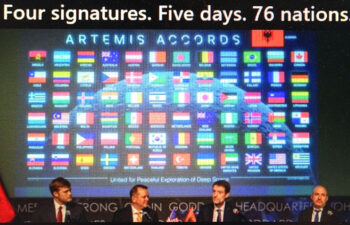
Perhaps the largest sub-group meeting at the IAC was the Oct. 5 Artemis Accords Principals’ Meeting, co-chaired by NASA Deputy Administrator Matt Anderson and Maj. Gen. Roberto Melgar Sheen, director of the Peruvian Space Agency (CONIDA).
A U.S. National Aeronautics and Space Administration (NASA) press release from Sept. 28 noted, “The meeting will examine ways to support emerging space nations and disseminate lunar debris mitigation recommendations.”
The Artemis Accords for peaceful conduct on the Moon started on Oct. 13, 2020, with five signatories (Australia, Canada, Italy, Japan, Luxembourg, United Arab Emirates, United Kingdom and U.S.) but by the end of September 2026 had gained 76 signatories, or nearly 40 percent of all countries on Earth.
In September alone new members included: San Marino (Sept. 26); Cote d’Ivoire (Sept. 25); Croatia (Sept. 23); Albania (Sept. 21); Djibouti (Sept. 14); and IAC host Turkey joined on August 31.
One reason the Artemis Accords have attracted such a large global following is that signatories commit to principles of positive behavior on the Moon that, as noted in the NASA press release, include:
• Explore peaceably and transparently;
• Render aid to those in need;
• Enable access to scientific data;
• Ensure activities do not interfere with others;
• Preserve historically significant sites and artifacts by developing best practices.
Another major attraction is that NASA is demonstrating that Artemis Accords signatories are potential partners for projects on the Moon by having committed to providing lunar astronauts slots to Japan, Italy Canada, the United Arab Emirates (UAE) and the European Space Agency (ESA).
Japan will send the first non-American Artemis-member astronauts to the Moon, with two Japanese astronauts slated to support the Japan Aerospace Exploration Agency’s (JAXA) Lunar Cruiser, a large pressurized lunar rover being co-developed by Toyota that could also serve as a small mobile habitat, scheduled to be lofted to the Moon in 2032.
Full Report . . . . Current Edition . . . . Subscription Information

Networking in outer space: U.S. and China offer contrasting incentives added by Editor Two on
View all posts by Editor Two →