
Special to WorldTribune, March 9, 2026
The following are excerpts from Government Gangsters, by Kash Patel in 2023. He was named Director of the FBI in 2025.

After my years as a public defender, I was hired by the National Security Division in DoJ headquarters (commonly referred to as Main Justice) in Washington, DC, as a terrorism prosecutor.
I started the job in the winter of 2013 to 2014 just as ISIS was beginning to emerge as an international threat. With terrorist attacks continuing around the world, my new job gave me the opportunity to save lives through my prosecutions and make a name for myself within the DoJ.
Prosecuting the Benghazi Terrorists
The September 11, 2012, attack in Benghazi, Libya, that killed four Americans —Ambassador Christopher Stevens, Foreign Service Officer Sean Smith, and two former Navy SEALs named Glen Doherty and Tyrone Woods — was a complete tragedy. It was also completely avoidable.
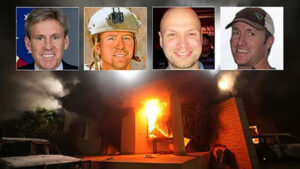
A large group of terrorists associated with al-Qaeda descended on our diplomatic compound and a nearby CIA facility over the course of the night as a result of massive and scandalous intelligence failures and security lapses. Leadership in the State Department, the CIA, and the Obama administration was caught completely unaware.
The American people were justifiably outraged. How could terrorists kill an American ambassador eleven years after 9/11? What the hell were our leaders doing — or not doing — that allowed this to happen?
Back in the States, it was clear President Obama thought he had a much bigger problem than the murder of Ambassador Stevens on his watch. He was in the final months of his reelection campaign, and one of his campaign’s core messages was that he had terrorism under control. In fact, he was running on the slogan “bin Laden is dead, and General Motors is alive.”
Benghazi blew that narrative to pieces. The terrorist attack was also a massive embarrassment for then secretary of state Hillary Clinton, who, as the head of the State Department, was ultimately responsible for the safety of her diplomats.
In order to deflect criticism away from themselves, the Obama administration engaged in a ludicrous disinformation campaign to spread the lie that the Benghazi attack happened because of an anti-Muslim video in another part of the world. How those things were connected they never did say and never could prove. The point was to find some excuse — any excuse — instead of what was obvious: that they failed to provide enough security for their ambassador and that President Obama and Hillary Clinton did not have a handle on terrorism.
Ultimately, they lied about what caused the death of four brave Americans for the sake of political expediency.
In the end, it worked. President Obama won reelection against the Republicans’ very weak candidate, Mitt Romney. Meanwhile, several government entities were still investigating what exactly had happened in Libya.
At the Department of Justice, I was part of the team conducting the criminal investigation into the Benghazi attack.
This wasn’t the same thing as a congressional inquiry designed to have public hearings and produce a report. This was a real-deal national security investigation created to assemble mountains of evidence in order to prosecute the terrorists who murdered four Americans.
It was no small task. After I started at the DoJ, I was embedded with America’s top special operations teams, through the US Special Operations Command (SOCOM), to help manage special military operations and maximize impact. As a representative from the DoJ, I was there to help manage the legal side of special operations. For example, if we found a terrorist, I was one of the stakeholders looking at the evidence, helping determine recommendations for what to do next, whether it was a drone strike, a Special Forces raid, or even attempting to capture the terrorist to bring him back to America for prosecution.
‘Captured Enemy Material’ and Eric Holder
Another important job of the DoJ liaison at SOCOM was to help find evidence in active conflict zones. We called it captured enemy material (CEM). It could be anything from witness testimony to surveillance footage to laptops and hard drives. The point was if we needed to prosecute a terrorist up to the American standards of justice, we needed to line up all of this material and turn it into evidence that was usable in a court of law in America, which was a monster lift.
Captured enemy material was exactly the type of on-the-ground evidence we were using in the Benghazi prosecution. By the time the DoJ was moving in full force to compile evidence and bring prosecutions against the Benghazi terrorists, I was leading the prosecution’s efforts at Main Justice in Washington, DC.
|
I could only come to one conclusion: whether it was Eric Holder or James Comey or anyone else with a high-level leadership position in the federal bureaucracy, all of their decisions were 100 percent political. |
The Benghazi prosecution was a monumental effort involving multiple teams at the department. My job was to help coordinate the efforts, working with the US attorney who would actually go to trial to get search warrants, approve indictments, and do all the necessary background work that has to take place long before a trial ever starts, including turning CEM into usable evidence.
While at Main Justice, I got a much closer view of the senior leadership of the department and other big names in Washington — people like Obama’s attorney general, Eric Holder, and his successor, Loretta Lynch, as well as other personalities who would soon become household names in America, like FBI Director James Comey and his deputy, Andrew McCabe.
Despite the fact that we had reams of evidence against dozens of terrorists in the Benghazi attack, Eric Holder’s Justice Department decided to only prosecute one of the attackers. Rank and file lawyers in the DoJ, like myself, told our leadership that we had the evidence to win against all of these terrorists, but they ignored us and only brought the cases that they deemed “fit.”
Knowing their decision to go soft on terrorists would cause a lot of grumbling, both in the department and among the American people, DoJ leadership then attempted to act tough against the one terrorist we were prosecuting by charging him with crimes that we didn’t have the evidence to support.
Because of that decision, when Main Justice asked me if I’d be willing to move to the trial team, I declined. I told them explicitly that I didn’t trust the prosecutorial decisions they were making. I ended up being proven right. On the entire second set of charges where I informed DoJ leadership that we didn’t have enough evidence, the Benghazi terrorist was acquitted on all such counts.
James Comey and The FBI’s Outsized Role
But it wasn’t just DoJ leadership making bad decisions. It was also the FBI, a sub-agency under the authority of the DoJ. While the DoJ may prosecute cases, the FBI is the entity tasked with collecting evidence. That means outside of the DoJ, the only people who knew the strength and breadth of the evidence we had against dozens and dozens of Benghazi terrorists were the investigators at the FBI.
But when Holder’s Justice Department decided not to prosecute, the FBI said nothing. It was easily within the power of people like Comey and McCabe to call up the Department of Justice, lay out the facts of the case, and say that they stood by the FBI’s work and that we had more than enough evidence to lock these terrorists up. But they didn’t. They let the evidence that their agents spent untold numbers of years collecting and processing sit and gather dust while terrorists avoided American justice.
And it’s not like senior leadership at the FBI was averse to pushing their preferred prosecutorial decisions. Within a few short years, Comey would go on national television and tell the world that he recommended no charges be brought against then presidential candidate Hillary Clinton for her unlawful mishandling of classified information on her private email servers.
His actions totally hijacked the role of the DoJ — which has sole discretion to make the decision whether or not to press charges — and politicized the Clinton investigation in an election year. It was not his call to make, but he didn’t seem to care.
So why was Comey so adamant to publicly and improperly influence the prosecutorial decision-making against Hillary Clinton but deathly silent, even on legitimate internal channels, when it came to Benghazi? Why did the Obama Justice Department decline to prosecute the rest of the Benghazi terrorists and then permit Comey to bandy about on the national stage, doing their political dirty work for them as America’s top cop?
As I sat there in the Department of Justice looking at all the information before me, I could only come to one conclusion: whether it was Eric Holder or James Comey or anyone else with a high-level leadership position in the federal bureaucracy, all of their decisions were 100 percent political.
Obama may have won reelection despite the Benghazi scandal, but by the time we were prosecuting some of the terrorists who committed the attack in 2014, Hillary Clinton was preparing her run to succeed Obama and become the next president. A high-profile court case that reviewed all the details of the Benghazi fiasco would hinder Hillary’s political chances, so the Obama administration and their FBI allies beat it all back.
What they wanted most of all wasn’t justice. It was political power. And in an attempt to keep political power, they threw out American justice, and terrorists went free on their watch.
Republish with FPI News Service

Part II: What mattered most about Benghazi for DOJ-FBI was political power added by Editor One on
View all posts by Editor One →