
by WorldTribune Staff / 247 Real News September 28, 2026
The U.S. Supreme Court on Friday rejected Missouri’s new congressional map.
For the third time in less than a month, the top court rejected the map intended to benefit Republicans in the November midterms.
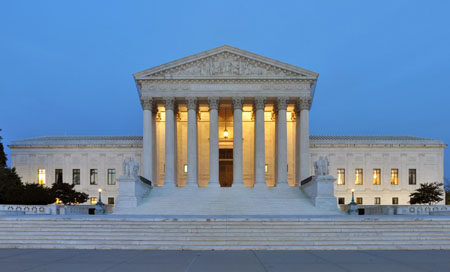
In a five-page, unsigned order, the justices paused a ruling by a federal appeals court in St. Louis that had directed the state to implement the new map.
In Friday’s opinion, which was released to reporters shortly before 6 p.m. EDT, the court emphasized that the federal district and appeals courts “should not enjoin or otherwise prohibit the use of the” map enacted in 2022, which is currently in use in voting already underway, “in the 2026 congressional election in Missouri.” Moreover, the court added, those courts “should not order or otherwise require Missouri to use the” new map “in the 2026 congressional election in Missouri.”
Missouri adopted the map that was intended to give Republicans an additional seat in the House.
On Sept. 4, Rep. Robert Onder, a Republican who won the Republican nomination for the state’s 3rd congressional district in the August 2026 primary, as well as another congressional candidate and two individual voters, filed a lawsuit in federal court in St. Louis, seeking to revive the new map.
Onder and the other candidate – Richard Brattin, who won the Republican nomination for the state’s 5th congressional district in August – contended that if the state were to use the previous map, from 2022, in the November elections, their districts would be significantly different from the districts in which they won the nominations in the August primary elections. The individual voters similarly argued that they would vote in a different district in November under the 2022 map than they had in August.
Shortly after the U.S. Supreme Court turned down Missouri’s request to pause the Missouri Supreme Court’s ruling, Chief U.S. District Judge Stephen Clark issued an order that directed the state to use the new map. Clark wrote that although “[c]onducting state elections in accordance with the Missouri Constitution undoubtedly qualifies as an important interest,” Onder and the other plaintiffs would “face irreparable harm” without a temporary restraining order “because many Missouri voters would have to cast their general-election votes for candidates whom they had no role in nominating.”
The dispute arrived at the Supreme Court for the second time on Sept. 9, when the justices were asked to intervene and pause the district court’s order. The next day, the Supreme Court – in a brief, unsigned order – did so, putting Clark’s order on hold “pending the disposition of the appeal in the United States Court of Appeals for the Eighth Circuit and disposition of a petition for a writ of certiorari in this Court, if such a writ is timely sought.”
The dispute then returned to the lower courts, where the 8th Circuit issued a decision upholding Clark’s order on Sept. 21. The court of appeals also directed Clark to enter a permanent order requiring the state to use the new map, but also to put that order on hold until 5 p.m. CDT on Sept. 28 to give the Supreme Court time to weigh in.
In its opinion on Friday, the Supreme Court began by observing that, “as a matter of state law, the 2022 map—not the 2025 map—must be used in the 2026 congressional election.” Moreover, the court added, putting the lower courts’ most recent rulings on hold is “[c]onsistent with” the Supreme Court’s Sept. 10 order pausing Clark’s earlier decision.
But “[e]ven putting this Court’s prior orders aside,” the court continued, the lower-court rulings should also be paused because “[t]he election is not merely upcoming; it has already started.” “At this late date,” the court wrote, reverting to the 2025 map “would usher in electoral chaos.”
Freedom Rocks! Until It Is Gone

Supreme Court for third time blocks Missouri’s redrawn congressional map added by Editor Two on
View all posts by Editor Two →