
by WorldTribune Staff / 247 Real News September 27, 2026
Having received a detailed briefing in a phone call from President Donald Trump following his summit with Chinese Communist Party leader Xi Jinping, Japanese Prime Minister Sanae Takaichi reassured the nation that Japan and the United States remain “the most mutually trusting of allies.”
The call aimed to reaffirm bilateral solidarity after remarks from the Trump-Xi summit recalling a wartime U.S.-China alliance reportedly unsettled Tokyo.
“But while the call — the second interaction between Trump and Takaichi in less than a week — may ameliorate immediate concerns of Beijing driving a wedge between Washington and Tokyo, the summit has triggered what are likely to be lasting concerns for Japan,” Jesse Johnson wrote for the Japan Times on Sunday.
“With bilateral ties deeply frayed following Takaichi’s comments last November in Parliament about the possibility of Japanese military intervention in a Taiwan crisis, China has rolled out an incessant and unyielding propaganda campaign against Tokyo.”
Takaichi is intent on dispelling any doubts about the strength of Tokyo’s alliance with Washington.
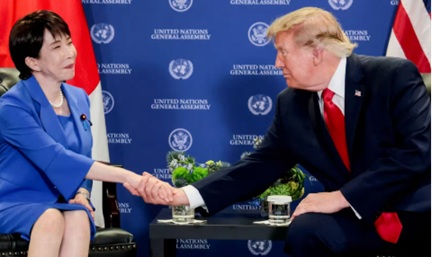
Takaichi met face-to-face with Trump in New York on the sidelines of the UN General Assembly on Sept. 22. The timing was a deliberate strategic play to align Tokyo and Washington’s positions just two days before Xi arrived in the U.S. capital.
Following the Trump-Xi meeting, Takaichi held an extensive follow-up phone call with Trump on Saturday, receiving a detailed briefing on the U.S.-China talks.
Takaichi heavily emphasized to the press that interacting with the U.S. President twice in one week is a clear demonstration of a strong and deeply trusting relationship. The leaders reportedly reaffirmed their commitment to joint economic security, tech cooperation, and keeping the Indo-Pacific stable.
Related: Japan’s Takaichi weathers China’s wrath, wins supermajority in landslide snap election gamble, February 8, 2026
Xi’s communist regime will almost certainly milk every ounce of symbolism out of the summit in Washington to further its narrative against Japan.
On Thursday, Trump hailed American and Chinese “common interests” that he said had “even made us allies in World War II” — even if it was the Kuomintang-led forces, not the communist side that currently runs China, that had joined hands with the U.S.
Speaking after Trump, Xi was quick to note in a speech that the Chinese and Americans had “fought shoulder to shoulder against fascist aggression.”
At the state dinner hosted by Trump on Thursday evening, Xi noted that the U.S. and Chinese had fought “against Japanese militarist aggressors.”
A fact sheet released by the White House on Saturday noted that China and the U.S. focused on an agreement “to build a constructive relationship of strategic stability on the basis of respect, fairness, and reciprocity” — but that document also doubled down on the historical significance of the superpowers’ relationship.
“The two leaders recalled that (the) United States and China were allies in World War II and fought side by side to win the war,” the fact sheet said.
Chinese state media and officials—including Foreign Minister Wang Yi and the state news agency Xinhua—spun the visit as a historic diplomatic success that projected China’s status as a near-equal superpower
China, mwanwhile, has accused Japan of making dangerous moves toward “remilitarization” in the wake of Takaichi’s Taiwan remarks in which the prime minister said a Chinese naval blockade or military attack on Taiwan could constitute a “survival-threatening situation” for Japan, potentially allowing Tokyo to exercise collective self-defense and deploy its Self-Defense Forces.
Xi’s regime also slapped Japanese firms with export controls on dual-use products and reportedly cut off exports of crucial rare-earth minerals.
As WorldTribune.com reported in July, Takaichi has not backed down. She continues to push practical security and material alliances across the Indo-Pacific to counter China’s belligerence.
In a post to LinkedIn, conservative commentator Edo Natio noted: “Xi Jinping has already lost ‘his’ war — not just with Japan, but with the entire First Island Chain, which is starting to align in sync under a quiet but sturdy Japanese leadership to deter CCP aggression.
“This is the very last thing Xi ever envisioned in 2012 when he believed that China had already achieved its strategic objective of completely pushing the U.S. out of the first and second island chains and establishing complete Chinese hegemony — the first step in his actual ‘China Dream’ on the road to global domination. He is now acting so goofy because he is genuinely shocked that a Japanese woman is doing that to him.
“Backed by substantial support in economic security and military security programs, Takaichi is well on the way to persuading the other member states of the FIC to come together in a First Island Chain Deterrence Association, not NATO, no Art. 5 — but a group of the willing to respond collectively when CCP China launches provocations against any member. This may sound weak to some, but CCP plans for decades have been about keeping all of the states isolated and weak. CCP assumes they can deal with other states one-on-one. If 5 or 7 FIC states collectively respond to the next egregious provocation in the SCS, then all of CCP propaganda turns to smog.”
As for the American side of the Xi=Trump summit, the White House stated:
“This state visit showcased the strength of the United States, advanced American economic interests, and made one thing unmistakable: peace and prosperity are strongest when America leads from a position of power.”
The fact that the U.S. and China did not issue a joint statement after the summit is a clear signal that there was little agreement. Xi Jinping did not come to Washington to engage with President Trump; he came to show CCP leaders back home that Trump honored him. @ShannonBream… https://t.co/wqatiHVFyJ
— Gordon G. Chang (@GordonGChang) September 27, 2026
Freedom Rocks! Until It Is Gone

‘The most mutually trusting of allies’: Takaichi reassures Japan following warm Trump-Xi summit added by Editor Two on
View all posts by Editor Two →