
by WorldTribune Staff, November 18, 2026 Non-AI Real World News
Japan’s energy lifeline to the Middle East accounts for approximately 90% to 95% of its crude oil imports. Nearly all passes through the Strait of Hormuz, with major suppliers being Saudi Arabia, the United Arab Emirates, Kuwait, and Qatar.
With Iran continuing to disrupt the flow of oil tankers through the strait, Japanese Prime Minister Sanae Takaichi is bracing for an unexpected challenge as she prepares to meet with U.S. President Donald Trump in the Oval Office on March 19.
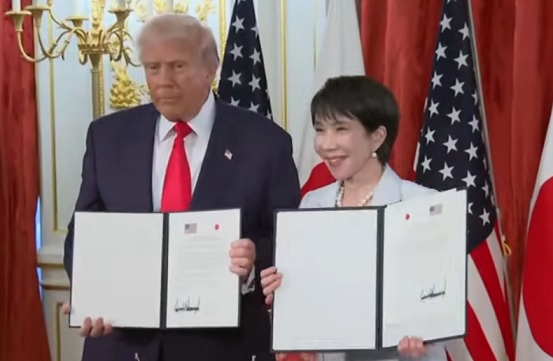
“Takaichi faces one of the toughest tests of her five-month premiership when she visits the White House on Thursday after Donald Trump urged Japan to send warships to the Strait of Hormuz,” the Financial Times noted in a March 17 analysis.
Takaichi is the first leader of an allied nation to visit the White House since the U.S. conflict with Iran began.
Kurt Campbell, deputy secretary of state during the Biden-Harris regime who worked with prior administration’s in Japan, told the Financial Times that Trump is likely to put “enormous pressure” on Takaichi to make a military commitment to the American campaign against Iran.
Takaichi has pledged to amend Japan’s pacifist constitution, which strictly limits what military operations it can undertake around the world.
Japan’s conservative Sankei newspaper on Tuesday bucked Japan’s legacy media consensus with an editorial urging Takaichi to dispatch naval vessels.
The Sankei editorial stated that the U.S.-Japan alliance risked becoming “dysfunctional,” warning Japan would “lose the honorable position it holds in the international community” if it failed to send ships while other countries did.
Some military analysts have suggested that Takaichi try to find a way to send some of Japan’s advanced minesweepers to assist U.S. efforts against Iran.
Related: Japan under PM Takaichi seen still speaking softly but with a very big stick, February 20, 2026
The Financial Times cited an individual “familiar with Takaichi’s thinking” as saying her visit to Washington would be a far cry from the leaders’ warm exchange in Tokyo in October, when they reaffirmed their alliance.
“Her ability to charm the guy is not the problem. The problem is substance. Last time there was no need for substance . . . but this time, Hormuz has created a real, concrete issue,” said the person, adding that, while Takaichi was likely to support the idea of dispatching military vessels, she would struggle to get domestic political support for such a move.
“The Japanese people are on board with upgrading Japan’s defensive military capabilities, but are not ready for force projection,” said the person.
Stephen Nagy, a Japan analyst at the International Christian University of Tokyo, said: “At the core of this, Japan wants to prevent Chinese hegemony in the region and will contort itself in every way to make sure that the U.S.-Japan alliance remains robust. They will be projecting the message that Japan is committed to the only game in town, and that is the U.S.”
Takaichi recently said no formal request had been made by the U.S. and that Japan had made no decision.
“But Japanese officials know that Trump could make a public request in the Oval Office in front of the media, which would put the Japanese leader in a difficult position,” the Financial Times analysis said.
“After her landslide election victory last month, Japanese officials assume Washington will heap pressure on her to take decisive action, knowing that she wields greater parliamentary control than her predecessors.”
2026 Contract With Our Readers

With her nation dependent on Mideast oil, Japan’s PM braces for high stakes Oval Office visit added by Editor Two on
View all posts by Editor Two →