
by WorldTribune Staff, September 14, 2026 Non-AI Real World News
Chinese Communist Party leader Xi Jinping used the BRICS leaders meet in India summit in New Delhi to rally global support against U.S. foreign policy.
Ahead of his Sept. 24 summit with President Donald Trump at the White House, Xi warned against “hegemonism, unilateralism, and protectionism,” three things the communist leader’s critics say perfectly encapsulate his own behaviors.
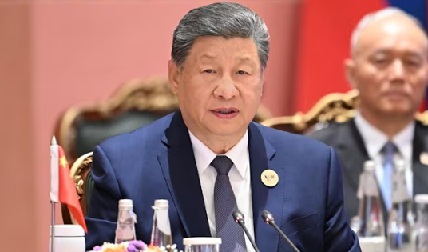
At the BRICS summit, Xi stated that international rules should apply to all countries equally without “Western double standards.”
Related: Xi has a message for President Trump at two pre-summit summits: I want your job, September 8, 2026
What message is Xi sending in advance of his meeting with Trump with his leading role at two international summits (Shanghai Cooperation Organization (SCO) from Aug. 1-Sept. 1 and BRICS)?
Writing in the current edition of Geostrategy-Direct, analyst Richard Fisher noted:
In essence, the CCP wants to displace the current Western-centric post-World War Two order with institutions that make the CCP the main source of global security and leadership, determining the myriad global rules and standards, or the job currently fulfilled in large part by the United States.
The BRICS group currently includes 11 full member countries: Brazil, China, Egypt, Ethiopia, India, Indonesia, Iran, Russia, Saudi Arabia, South Africa, and United Arab Emirates.
Xi’s plan to build independence from Western systems includes:
• Technology and AI: Create a BRICS artificial intelligence open-source community.
• Trade and industry: Build digital ecosystem platforms and special economic zones.
• Financial reform: Push for trade in local currencies to reduce reliance on the U.S. dollar.
• Global governance: Support the central role of the United Nations and reform global financial institutions to give developing nations a bigger voice.
Xi urged BRICS leaders to “stay on the right side of history” and oppose America’s tough policies from the Middle East to Asia.
New York Sun columnist Donald Kirk noted: “The conference host, Prime Minister Narendra Modi of India, was seen grasping the left hand of Iran’s president, Masoud Pezeshkian, on his right and the right hand of President Vladimir Putin of Russia on his left.
“The BRICS nations scored a diplomatic triumph in a joint statement that papered over deep differences between Iran and the United Arab Emirates, sometimes a target for missiles fired by Iran across the Persian Gulf.
“It was only after Pezeshkian had met the UAE president, Mohamed bin Zayed, that the BRICS leaders came up with a joint declaration that was critical, but not as critical as Iran might have liked, of the American role in the Iran war. bin Zayed was there as leader of one of 10 ‘outreach’ countries invited to participate.”
The U.S. and Israel were not mentioned by name in the statement, which denounced “deliberate attacks on civilian infrastructure and peaceful nuclear facilities under full safeguards of the International Atomic Energy Agency.”
Referring to the American bombing of Iran’s deepest nuclear facilities in June of last year, the statement said “nuclear safeguards, safety, and security must always be upheld, including in armed conflicts, to protect people and the environment from harm.”
Xi took an obvious dig at the U.S.’s role in conflicts on opposite sides of Asia when he said: “Countercurrents of unilateralism and power politics are surging. Multilateralism and the international order are coming under strain, and deficits in peace, development, security and governance continue to widen.”
BRICS countries, he said, “should firmly stand on the right side of history, strive to be a pioneer of the times, steer the international order toward greater justice and equity.”
Kirk noted: “Xi also raised another topic that is sure to come up in his conversation with Trump: BRICS participation in the World Artificial Intelligence Cooperation Organization.”
Xi said: “China proposed an initiative to promote new industrialization through artificial intelligence among BRICS countries … and deepen cooperation in industrial and supply chains.”
For Xi, Kirk concluded, the BRICS conference “was a chance to build up his own role while rationalizing and papering over differences.”
“The next summit in China,” said a commentary carried by Xinhua, the state news agency, “will help BRICS build even stronger consensus, deepen practical cooperation and strive for a greater voice of the Global South.”
Freedom Rocks! Until It Is Gone

Xi Jinping at BRICS mobilizes global support against U.S. foreign policy added by Editor Two on
View all posts by Editor Two →