
Special to WorldTribune.com
 By John J. Metzler, August 20, 2026
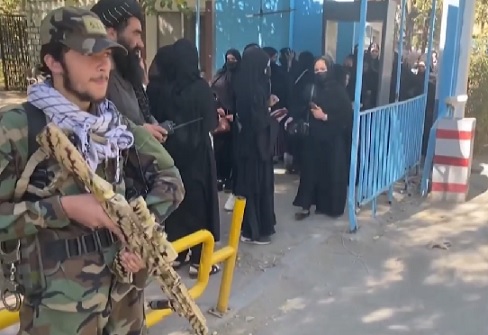
Five years after the fall of Kabul and the collapse of the Western-backed Afghan government to the Taliban militants, the situation in the beleaguered South Asian state has deteriorated into a humanitarian morass and a staggering social dystopia especially for the female population. According to UN officials, “What has unfolded since then has no parallel in the modern world.”
Susan Ferguson, UN special representative in Afghanistan for UN Women commented, “Year by year the de-facto authorities have systematically dismantled the rights of women and girls issuing more than 100 hundred decrees which have stripped away their rights and institutionalized discrimination against them.”
She added, “Afghanistan is the only country in the world where women and girls face such far-reaching restrictions on their education, work, movement, and public participation and legal equality.”
Since the Taliban takeover no foreign government, except Russia, has offered formal diplomatic recognition to the “Islamic Emirate of Afghanistan”. Moreover, the Afghan seat in the UN General Assembly remains vacant as the UN refuses to recognize Taliban, referring to them as the de-facto authorities.
Despite a nearly twenty-year commitment of American forces to battle the Islamic fundamentalist Taliban, one of the many reasons Afghanistan collapsed was deep corruption, ethnic rivalries and a default decision to let the American forces do the heavy lifting and fighting.
An overdue phased withdrawal of American forces during the first Trump Administration reached an “agreement” with the Taliban that they would not target U.S. troops.
Nonetheless the terrorists would then simply bide their time, recalling an old Taliban quip, “You have the watches, We have the time.”
But by 2021 in the giddy early months of the new Biden term, the Taliban reassessed their position. Probing attacks were made throughout the country on weak government-controlled garrison towns and provinces.
In July the balance of power began to drastically tip and then simply collapse with the fall of Kabul, the capital.
Just before the end, a largely U.S. NATO’s Resolute Support Security mission backed by troops from 10 other countries among them France, Germany, Italy and the UK began to withdraw.
President Biden and the State Department later offered stunningly cynical explanations for the debacle; Joe Biden conceded on Aug. 16 that “this did unfold more quickly than we had anticipated”.
The national shame and humiliation of Kabul’s collapse on Aug. 15, 2021, marked the rapid fall of the U.S.-supported Afghan government and the return of the fundamentalist Taliban to power. The largely mediocre Afghan army imploded like a house of cards and the regime of President Ashraf Ghani fled the country as expected to the United Arab Emirates.
Before long, an airlift with a stream of Afghan refugees was flowing from besieged Kabul; Over 123,000 Afghans were carried out. But in the chaos and confusion a terrorist suicide bomb killed 13 U.S. Marines marking the last American losses of the tragic Afghan war.
The shambolic pullout of the remaining American forces as well as Afghan refugees, many of whom had genuinely helped the U.S. war effort, echoed Saigon in 1975 but refocused attention to the current state of American preparedness, and especially commitment.
But the tragedy was hardly over when the war ended.
Immediately, the Islamist Taliban regime set about disenfranchising half the population, Women, through draconian edicts, not only in terms of restrictions on educational and social opportunities but simple human rights of leaving one’s house at will.
In a joint statement supported by 56 member states, Denmark’s UN Amb. Christina Markus Lassen decried “the Taliban’s systematic repression of women and girls, the restrictions on their fundamental rights and freedoms, and the prohibition on Afghan female UN staff.” Denmark’s envoy described the fifth anniversary of the Taliban’s return to power in Afghanistan as “rather a grim anniversary.”
Indeed, gloom descended upon the land and has continued since. But beyond the tragedy which befell Afghanistan, the political ramifications were wider.
Tyrants such as Russia’s Vladimir Putin and China’s Xi Jinping among others became emboldened and presumed that America’s resolve was weak and that aggression would presumably not have a heavy price.
The aftershocks of Kabul’s collapse would soon inspire and embolden Russia’s leadership to take a reckless gamble to seize Ukraine.
Assessing the political indecision of the Biden Administration, Vladimir Putin gambled on a quick “special military operation” in February 2022 in which the Russians figured would offer a low cost high gain operation.
The Ukrainians proved Putin stunningly wrong.
China’s Xi Jinping thus looks to Taiwan with prudent restraint. Dictators take note.
John J. Metzler is a United Nations correspondent covering diplomatic and defense issues. He is the author of Divided Dynamism the Diplomacy of Separated Nations: Germany, Korea, China (2014). [See pre-2011 Archives]

Afghan aftershocks 5 years after Kabul’s collapse; 100 decrees target women and girls added by Editor One on
View all posts by Editor One →