
by WorldTribune Staff, September 28, 2026 Non-AI Real World News
The ultimate goal of the Trump Administration’s intense economic pressure campaign is to force Iran into a position where it must adhere to any future agreement, U.S. Treasury Secretary Scott Bessent said.
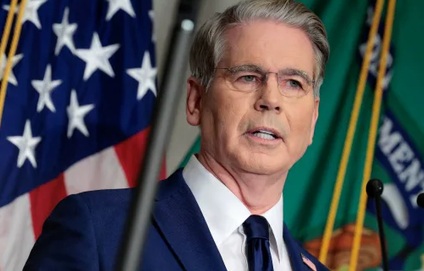
During an interview on Fox News’s Sunday Morning Futures, Bessent detailed the progress of Operation Economic Outcast, stating that President Donald Trump’s strict naval blockade has decimated Iran’s economy and left the country with fewer than 15 million barrels of oil out for delivery.
Bessent predicted that Iran would finish its final remaining crude oil deliveries to China within two weeks, leaving the regime with “nothing left to trade for anything.”
Bessent connected this strategy directly to making sure Iran honors its commitments, stating:”They are isolated from the world. They’re a pariah state. And my job is to make sure that, when they come with a deal, that they want to stick to it. They did not stick to the MOU [Memorandum of Understanding]. And, next time, if there is a deal — that’s at President Trump’s discretion — that they will stick to it, because they are on their knees.”
The Treasury Department is attempting to “economically asphyxiate” the Iranian regime by severing its global financial channels, shutting down international flights for Iranian airlines, and blocking banking systems.
By drying up Iran’s oil lifelines and foreign currency reserves, the administration intends to build structural leverage. The objective is to ensure that if Trump decides to finalize a new agreement, Iran will face too much economic vulnerability to risk violating the terms.
Bessents comments came as Teheran proposed a seven-day ceasefire that would reopen the Strait of Hormuz in exchange for the U.S. releasing roughly $12 billion in frozen Iranian assets, lifting its naval blockade, and waiving sanctions on Iranian oil sales.
Trump flatly rejected the proposal, telling reporters the terms were unacceptable.
Bessent said oil traffic through the Strait of Hormuz has already rebounded despite sporadic Iranian attacks on shipping.
“The straits are open,” Bessent said. “We’re averaging now 15 to 22 million barrels a day. … It was at about 20 [million] pre-conflict.”
250 Years of Freedom Is At Risk

Bessent sees his role as making sure that next time Iran ‘sticks to the deal’ added by Editor Two on
View all posts by Editor Two →