
by WorldTribune Staff, August 16, 2026 Non-AI Real World News
U.S. Central Command (CENTCOM) on Thursday announced it is establishing the first multi-domain, multinational attack drone task force.
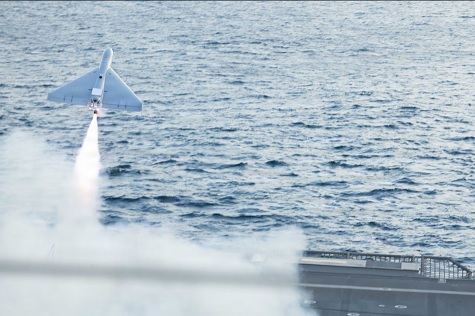
Task Force Falcon Strike integrates American military personnel and regional partner nations to operate one-way attack drones and unmanned systems across the air, sea surface, and underwater domains, the Department of War said in a press release.
The Falcon Strike initiative was announced nine months after CENTCOM established Task Force Scorpion Strike, the U.S. military’s first dedicated one-way attack drone squadron in the Middle East.
Scorpion Strike rapidly achieved key operational milestones, including the first launch of an aerial attack drone from a Navy warship last December. The squadron also employed one-way unmanned aerial systems during Operation Epic Fury and during strikes on Iranian port facilities in July using unmanned attack vessels at sea.
“Task Force Falcon Strike will expand on Scorpion Strike’s success given the tremendous innovation happening among our regional allies and partners,” said Navy Adm. Brad Cooper, CENTCOM commander. “Integrating and deploying our new capabilities together will help us rapidly realize the new possibilities that are on the horizon.”
“The United States military has a lot of strong partnerships and friends in the region,” Cooper said. “We are collectively stronger when we integrate and deploy new capabilities together.”
Personnel from U.S. Special Operations Command Central, which launched Scorpion Strike, will lead Falcon Strike’s staff of U.S. and regional representatives.
Meanwhile, the USS George Washington is departing the Pacific and is expected to replace the USS Abraham Lincoln in the Middle East. The Lincoln has had its time at sea extended from its original May return date to support operations against Iran.
The lack of a U.S. carrier in the Pacific is expected to be short-lived as the Navy may deploy another in the next couple of months.
Analysts say the absence of a U.S. carrier in the Pacific may provide China with another opportunity to project its power.
“They’re using this as part of the narrative to demonstrate to the Philippines, to Japan, to Indonesia and others that the U.S. is not the big dog in the western Pacific anymore,” said Bryan Clark, a former Navy submariner who is a defense analyst at the Hudson Institute. “They would just prefer that countries in the region decide that China is the bigger power and the U.S. is not able to guarantee their security anymore.”
China conducted naval exercises in the last week with Indonesia and recently has shown signs of aggression toward Japan and the Philippines, two key U.S. allies that also have territorial disputes with Beijing.
China carried out military drills this month near the Scarborough Shoal in the South China Sea. Both China and the Philippines have claims over the shoal. Last month, a Chinese guided-missile destroyer conducted a live-fire exercise off Japan’s southernmost island of Okinotori.
Freedom Rocks! Until It Is Gone

CENTCOM initiates attack drone task force for Middle East added by Editor Two on
View all posts by Editor Two →