
Analysis by WorldTribune Staff, October 30, 2026 — Real World News
Leftist South Korean President Lee Jae-Myung’s push to regain wartime operational control (OPCON) by 2030 could dismantle the joint U.S.-South Korea command structure, trigger a downsizing of U.S. Forces Korea (USFK), and hand a significant strategic victory to communist China.
Lee, who took office in June 2025 following the impeachment of conservative President Yoon Suk-Yeol, leads a leftist administration that views regaining OPCON as a matter of national sovereignty.
Under current arrangements dating back to the Korean War, an American general would command combined forces if a war broke out. Lee wants a South Korean general in charge before his term ends in 2030.
Washington believes an OPCON transfer must be strictly conditions-based, citing North Korean provocations and missing intelligence assets.
U.S. Secretary of War Pete Hegseth and South Korean Defense Minister Kang Shin-Chul agreed to delay their annual security dialogue to early 2027 to iron out these rifts.
Following South Korea’s refusal to assist in the Middle East, Washington unilaterally scaled back major joint military exercises. Critics note this makes the alliance feel increasingly transactional, feeding anxieties that a drawdown could occur if terms aren’t met.
U.S. military commanders, such as 8th Army Lt. Gen. Joseph Hilbert, argue that U.S. troops in Korea must have “strategic flexibility” to address threats beyond North Korea—specifically to deter China.
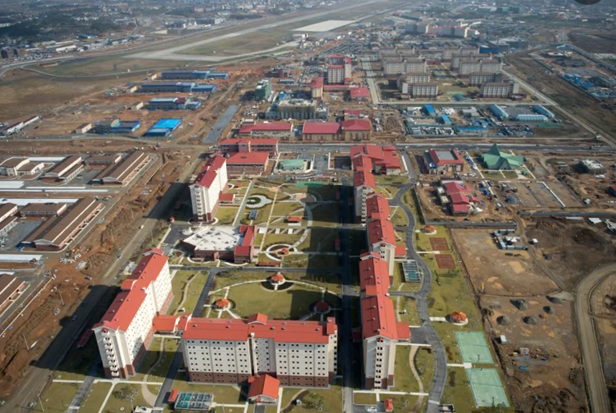
Camp Humphreys in Pyeongtaek is America’s largest overseas military base, serving as a critical surveillance and military platform just 186 miles from China’s Shandong province. A restructured or downsized presence would diminish the U.S. capability to contain China in the Indo-Pacific.
Home to most of the more than 28,000 American troops stationed in South Korea, Camp Humphreys provides key command, training and depot facilities to soldiers tasked with deterring North Korea. Along with two sister installations on South Korea’s Yellow Sea coast, it also offers America a proximate eye on China.
A U.S. public affairs official calls the base the “center of gravity” of the Seoul-Washington alliance.
On the edge of Pyeongtaek town, the base was activated as the hub for U.S. Forces Korea in 2018. Korean taxpayers paid 90% of the $11 billion cost.
From Seoul’s perspective, allowing the U.S. to use its South Korean bases for a regional conflict (like a Taiwan Strait crisis) invites direct Chinese military retaliation against South Korea.
Critics of Lee’s policy warn that moving away from a U.S.-led command structure reduces the ironclad nature of the American nuclear umbrella, especially as North Korea cements modern battlefield experience and tightens ties with Russia.
Meanwhile, former President Yoon explains in an interview why he declared martial law as partisan prosecutors seek the death penalty.
President Yoon Suk-Yeol explains why he declared Emergency Martial Law in 2024.
He saw that the country was in danger (from subversion by China, North Korea, & their supporters–supporting socialism run by communists).
Despite the North Korean spy cases, Chinese spy cases, & various other threats to the RepublicofKorea (ROK), most went about their business, not realizing the full threat. The media wasn’t helpful.
Meanwhile, the legislature acted like a dictator. Among others, it paralleled the Executive branch by arbitrarily de-funding it.
He felt he had to do something to warn people. He looked at the tool he had as the president. He tried conversations with the public. He tried other methods. But still, no avail. He needed somethuthat would get the attention of the people. The only “emergency ” declaration he could declare was the Emergency Martial Law (there’s also the Wartime Martial Law.) He didn’t want yo use the military, but that’s what he had.
So Emergency Martial Law was declared.
—
And it did wake people up. This is a great feat, because it’s hard to do.It did come at a cost. He & his wife are imprisoned. Also, many other patriots in the military & government & the society are imprisoned.
But people, especially the youths, have awakened. And they are stepping forward to fight for freedom; rule of law: fair, free, & credible elections; separation of power & checks and balances; protection of private property.
https://t.co/Z04KX4eCVH— Tara O (@DrTaraO) October 29, 2026
A South Korean special prosecutor on Thursday demanded the death penalty for ousted President Yoon Suk Yeol, ahead of an appeals court verdict on rebellion charges over his brief imposition of martial law in December 2024.
The Seoul High Court has yet to set a date for a verdict on Yoon’s appeal of a life sentence handed down in February by the Seoul Central District Court. The court found that he illegally mobilized troops and police to seize the legislature, arrest political opponents and establish unchecked rule for a “considerable time.”
Investigators led by Special Prosecutor Cho Eun-Suk also appealed the ruling, arguing Yoon deserves the death penalty because his actions posed a grave threat to the country’s democracy. An execution would be unlikely. South Korea has not executed anyone since 1997, effectively maintaining a moratorium on capital punishment following calls for its abolition.
Freedom Rocks! Until It Is Gone

Demands by Seoul’s leftist president could end U.S. military presence in Korea in win for China added by Editor Two on
View all posts by Editor Two →